Izanagi
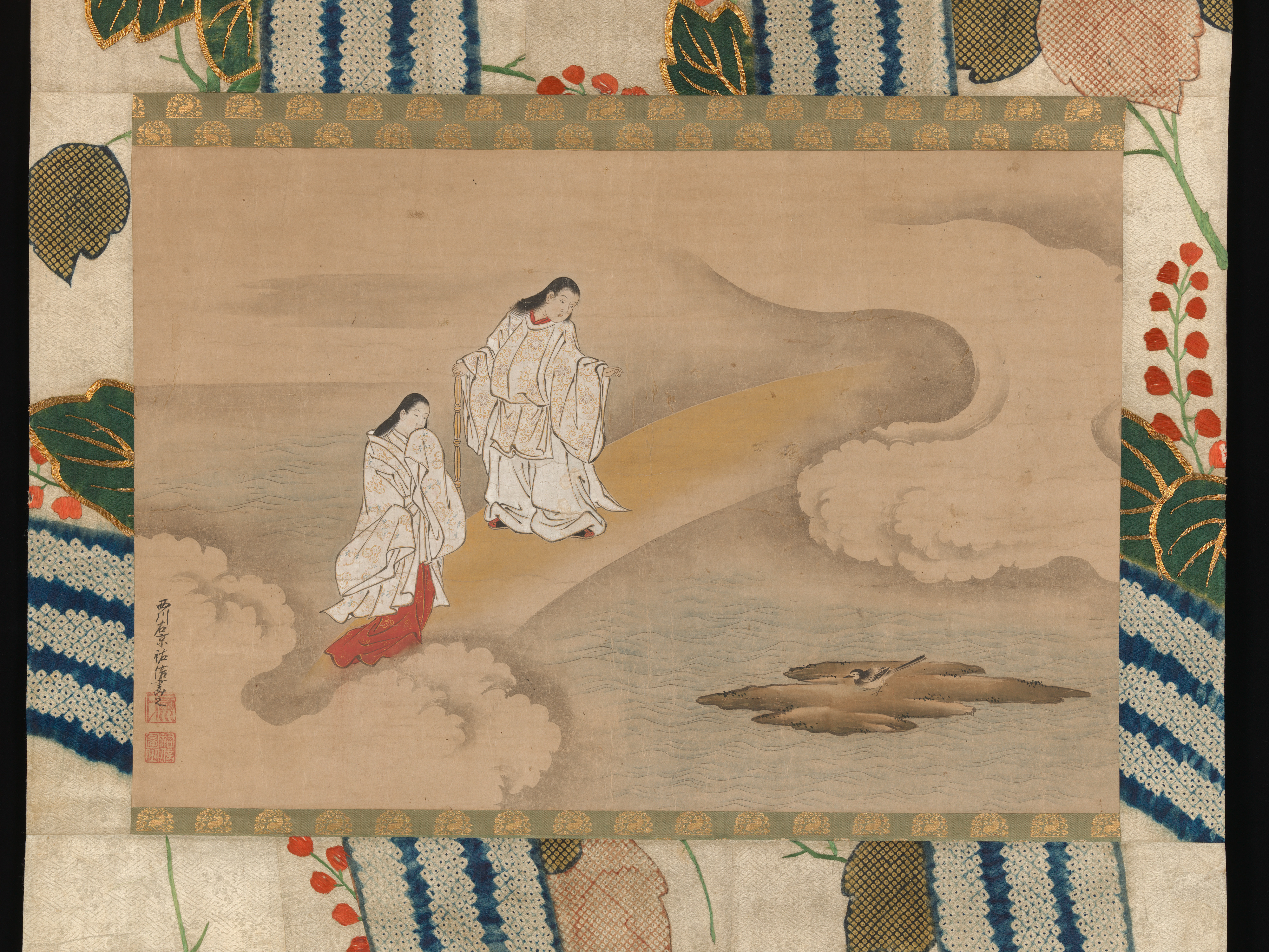
Male member of the divine creator pair who, with his sister-wife Izanami, stirred the brine of the sea to form the Japanese islands and gave birth to the high deities.
Who they are
- Stirs the sea with the jeweled spear Ame-no-nuhokohe to form the first island, Onogoro [S1]S1 · *Kojiki* ('Records of Ancient Matters', 712 CE), trans. Basil Hall Chamberlain (1882/1933) — PRIMARY TRANSLATION — https://sacred-texts.com/Open source ↗.
- His purification (misogi) after fleeing Yomi gives birth to a series of deities from his washed body-parts [S1]S1 · *Kojiki* ('Records of Ancient Matters', 712 CE), trans. Basil Hall Chamberlain (1882/1933) — PRIMARY TRANSLATION — https://sacred-texts.com/Open source ↗.
- The 'floating bridge of heaven' (Ame-no-ukihashi) is the platform from which he and Izanami work [S1]S1 · *Kojiki* ('Records of Ancient Matters', 712 CE), trans. Basil Hall Chamberlain (1882/1933) — PRIMARY TRANSLATION — https://sacred-texts.com/Open source ↗.
- The precise order and parentage of the children (which islands and which kami, and in what sequence) differ between the Kojiki and Nihon Shoki [S1]S1 · *Kojiki* ('Records of Ancient Matters', 712 CE), trans. Basil Hall Chamberlain (1882/1933) — PRIMARY TRANSLATION — https://sacred-texts.com/Open source ↗[S2]S2 · *Nihon Shoki* ('Chronicles of Japan', 720 CE) — PRIMARY TEXT (annalistic + mythographic) — (translation: G. Cameron, 1968; see Internet Arch.
- The details of the Yomi episode (the separation point, the 'Nagarazuyashiki' hedge of hedges, which body-parts birth which kami) vary between the two texts [S1]S1 · *Kojiki* ('Records of Ancient Matters', 712 CE), trans. Basil Hall Chamberlain (1882/1933) — PRIMARY TRANSLATION — https://sacred-texts.com/Open source ↗[S2]S2 · *Nihon Shoki* ('Chronicles of Japan', 720 CE) — PRIMARY TEXT (annalistic + mythographic) — (translation: G. Cameron, 1968; see Internet Arch.
Connections
4 rows · 8 recorded edges — identical notes are grouped
Family & kinship
Partners
Creation
Artifacts
Their corner of the divine world
- parentage
- marriage ♥
far = primordials · medium = all · close = detail — scroll/pan, click a deity to focus
3 stories
The Primordial Beginning and the High Plain of Heaven
In the Kojiki's opening, when 'the heavenly high plain had just come into being,' the first-born deity Takamimusubi ('the high divine origin of heavenly things') is named, and the deities of the High Plain of Heaven (Amenominakanushi) 'give birth to' or command the birth of the creator pair Izanagi and Izanami, ordering them to shape and settle the earthly islands [S1]S1 · *Kojiki* ('Records of Ancient Matters', 712 CE), trans. Basil Hall Chamberlain (1882/1933) — PRIMARY TRANSLATION — https://sacred-texts.com/Open source ↗. This establishes the vertical cosmology: a high heavenly realm above, an earthly realm below, with the creative pair sent from above to order the world below [S1]S1 · *Kojiki* ('Records of Ancient Matters', 712 CE), trans. Basil Hall Chamberlain (1882/1933) — PRIMARY TRANSLATION — https://sacred-texts.com/Open source ↗[S2]S2 · *Nihon Shoki* ('Chronicles of Japan', 720 CE) — PRIMARY TEXT (annalistic + mythographic) — (translation: G. Cameron, 1968; see Internet Arch.
Izanagi and Izanami Form the Islands
The creator pair Izanagi and Izanami stand on the Floating Bridge of Heaven (Ame-no-ukihashi) and, with the jeweled spear Ame-no-nuhokohe, stir the brine of the deep sea; the salt that drips from the spear forms the first island, Onogoro [S1]S1 · *Kojiki* ('Records of Ancient Matters', 712 CE), trans. Basil Hall Chamberlain (1882/1933) — PRIMARY TRANSLATION — https://sacred-texts.com/Open source ↗. There they wed and, in a series of 'birthings,' produce the great islands of Japan (naming them as they are formed) and then the deities (kami) who attend them [S1]S1 · *Kojiki* ('Records of Ancient Matters', 712 CE), trans. Basil Hall Chamberlain (1882/1933) — PRIMARY TRANSLATION — https://sacred-texts.com/Open source ↗. The sequence of islands and the sequence of kami are given in the text, though the two lists differ between the Kojiki and Nihon Shoki [S1]S1 · *Kojiki* ('Records of Ancient Matters', 712 CE), trans. Basil Hall Chamberlain (1882/1933) — PRIMARY TRANSLATION — https://sacred-texts.com/Open source ↗[S2]S2 · *Nihon Shoki* ('Chronicles of Japan', 720 CE) — PRIMARY TEXT (annalistic + mythographic) — (translation: G. Cameron, 1968; see Internet Arch.
Izanami's Death and the Separation of the World (Izanagi's Purification)
In giving birth to the fire god Kagutsuchi, Izanami is burned and dies [S1]S1 · *Kojiki* ('Records of Ancient Matters', 712 CE), trans. Basil Hall Chamberlain (1882/1933) — PRIMARY TRANSLATION — https://sacred-texts.com/Open source ↗. Izanagi descends to the Land of Yomi to bring her back; finding her decayed and attended by the 'devils of rotting,' he flees, and the two are separated at the threshold—the mythic origin of the divide between the clean world of the living and the polluted realm of the dead [S1]S1 · *Kojiki* ('Records of Ancient Matters', 712 CE), trans. Basil Hall Chamberlain (1882/1933) — PRIMARY TRANSLATION — https://sacred-texts.com/Open source ↗. Fleeing to the world of the living, Izanagi performs a ritual purification (misogi), washing his body; from his washed body-parts a series of kami are born, and the separation is made permanent [S1]S1 · *Kojiki* ('Records of Ancient Matters', 712 CE), trans. Basil Hall Chamberlain (1882/1933) — PRIMARY TRANSLATION — https://sacred-texts.com/Open source ↗. This is the foundational myth of death, impurity (kegare), and purification in Japanese religion [S1]S1 · *Kojiki* ('Records of Ancient Matters', 712 CE), trans. Basil Hall Chamberlain (1882/1933) — PRIMARY TRANSLATION — https://sacred-texts.com/Open source ↗[S2]S2 · *Nihon Shoki* ('Chronicles of Japan', 720 CE) — PRIMARY TEXT (annalistic + mythographic) — (translation: G. Cameron, 1968; see Internet Arch.
Objects they wielded, forged, or were bound to
INTERPRETIVE CLASSIFICATION · FULL PROFILE IN THE DIVINE VAULT

Depictions

