Izanagi and Izanami Form the Islands
The creator pair Izanagi and Izanami stand on the Floating Bridge of Heaven (Ame-no-ukihashi) and, with the jeweled spear Ame-no-nuhokohe, stir the brine of the deep sea; the salt that drips from the spear forms the first island, Onogoro [S1]S1 · *Kojiki* ('Records of Ancient Matters', 712 CE), trans. Basil Hall Chamberlain (1882/1933) — PRIMARY TRANSLATION — https://sacred-texts.com/Open source ↗. There they wed and, in a series of 'birthings,' produce the great islands of Japan (naming them as they are formed) and then the deities (kami) who attend them [S1]S1 · *Kojiki* ('Records of Ancient Matters', 712 CE), trans. Basil Hall Chamberlain (1882/1933) — PRIMARY TRANSLATION — https://sacred-texts.com/Open source ↗. The sequence of islands and the sequence of kami are given in the text, though the two lists differ between the Kojiki and Nihon Shoki [S1]S1 · *Kojiki* ('Records of Ancient Matters', 712 CE), trans. Basil Hall Chamberlain (1882/1933) — PRIMARY TRANSLATION — https://sacred-texts.com/Open source ↗[S2]S2 · *Nihon Shoki* ('Chronicles of Japan', 720 CE) — PRIMARY TEXT (annalistic + mythographic) — (translation: G. Cameron, 1968; see Internet Arch.
Shinto is a living religious tradition. These narratives are presented as the tradition's own mythic heritage, with the historical layers (Kojiki 712 CE, Nihon Shoki 720 CE, shrine engi) made visible. Modern state-Sinto and pop-culture readings are labeled separately from the primary texts.
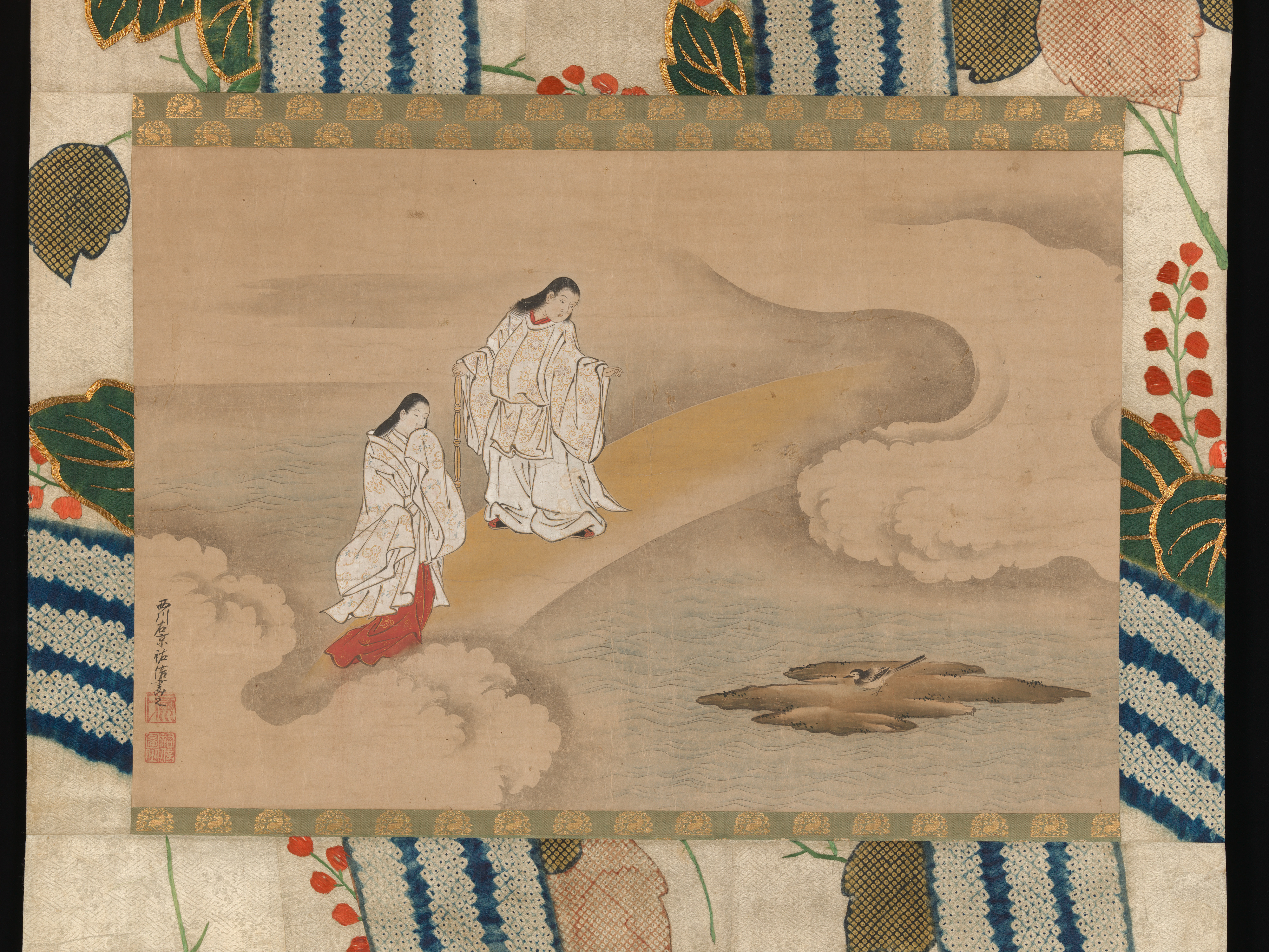
The exact list and order of the islands, and which kami are born in which 'birthing,' differ between the Kojiki and Nihon Shoki [S1]S1 · *Kojiki* ('Records of Ancient Matters', 712 CE), trans. Basil Hall Chamberlain (1882/1933) — PRIMARY TRANSLATION — https://sacred-texts.com/Open source ↗[S2]S2 · *Nihon Shoki* ('Chronicles of Japan', 720 CE) — PRIMARY TEXT (annalistic + mythographic) — (translation: G. Cameron, 1968; see Internet Arch.
The Floating Bridge

The First Island
The Islands and the Kami

Variants of this story (2)
The Kojiki names the islands in a specific order as they are 'born.'
The Nihon Shoki gives a related but not identical list and order of the islands.