Gallery · c. 712 CE texts · living tradition

Japanese Mythology

日本神話
21 entities51 relationships7 myths29 artworks
living religious tradition

Shinto is a living religious tradition. These narratives are presented as the tradition's own mythic heritage, with the historical layers (Kojiki 712 CE, Nihon Shoki 720 CE, shrine engi) made visible. Modern state-Sinto and pop-culture readings are labeled separately from the primary texts.

01 — Cosmology

The shape of the world


A vertical three-tier cosmology: Takamagahara (high heaven) above, Ashihara-no-Nakatsukuni (the earthly middle land) in the middle, and Yomi (the land of the dead) below. The 'floating bridge of heaven' (Ame-no-ukihashi) and the 'heavenly pillar' (Amanohabaki) are the axis connecting the upper and middle realms. This is the Kojiki/Nihon Shoki model; it is a mythographic (8th-century) rendering of an older cosmology, and the precise spatial relationships are not fully specified in the texts [S1]S1 · *Kojiki* ('Records of Ancient Matters', 712 CE), trans. Basil Hall Chamberlain (1882/1933) — PRIMARY TRANSLATION — https://sacred-texts.com/Open source ↗[S2]S2 · *Nihon Shoki* ('Chronicles of Japan', 720 CE) — PRIMARY TEXT (annalistic + mythographic) — (translation: G. Cameron, 1968; see Internet Arch.


02 — The relationship graph

How the divine world is wired


Two ways to read the same data: the genealogy view layers generations top → bottom (partners side by side, children fanning from the union), while the relationships view shows the full web of typed relationships — filter by category, or click any node to open its profile. Line style encodes confidence: solid = attested, dashed = disputed, dotted = scholarly reconstruction.

View
hierarchical — generations top → bottom, partners side by side
Overlays
JAPANESE · 21♥♥♥Kusanagi-no-Tsu…Yasakani no Mag…Yata no KagamiAme-no-NubokoAme-no-UzumeAmenominakanushiInariIzanagiIzanamiTakamimusubiKotohikoneKushinada-himeNinigiŌkuninushiSarutahikoTakemikazuchiYamata-no-OrochiYamato TakeruAmaterasuKagutsuchiKonohanasakuya-h…SusanooTsukuyomiToyotama-himeHooroni (Ōyahata)
zoom 2.30× · medium
  • parentage
  • marriage ♥

far = primordials · medium = all · close = detail — scroll/pan, click a deity to focus


03 — Major myths

The stories

The Primordial Beginning and the High Plain of Heaven

In the Kojiki's opening, when 'the heavenly high plain had just come into being,' the first-born deity Takamimusubi ('the high divine origin of heavenly things') is named, and the deities of the High Plain of Heaven (Amenominakanushi) 'give birth to' or command the birth of the creator pair Izanagi and Izanami, ordering them to shape and settle the earthly islands [S1]S1 · *Kojiki* ('Records of Ancient Matters', 712 CE), trans. Basil Hall Chamberlain (1882/1933) — PRIMARY TRANSLATION — https://sacred-texts.com/Open source ↗. This establishes the vertical cosmology: a high heavenly realm above, an earthly realm below, with the creative pair sent from above to order the world below [S1]S1 · *Kojiki* ('Records of Ancient Matters', 712 CE), trans. Basil Hall Chamberlain (1882/1933) — PRIMARY TRANSLATION — https://sacred-texts.com/Open source ↗[S2]S2 · *Nihon Shoki* ('Chronicles of Japan', 720 CE) — PRIMARY TEXT (annalistic + mythographic) — (translation: G. Cameron, 1968; see Internet Arch.

Izanagi and Izanami Form the Islands

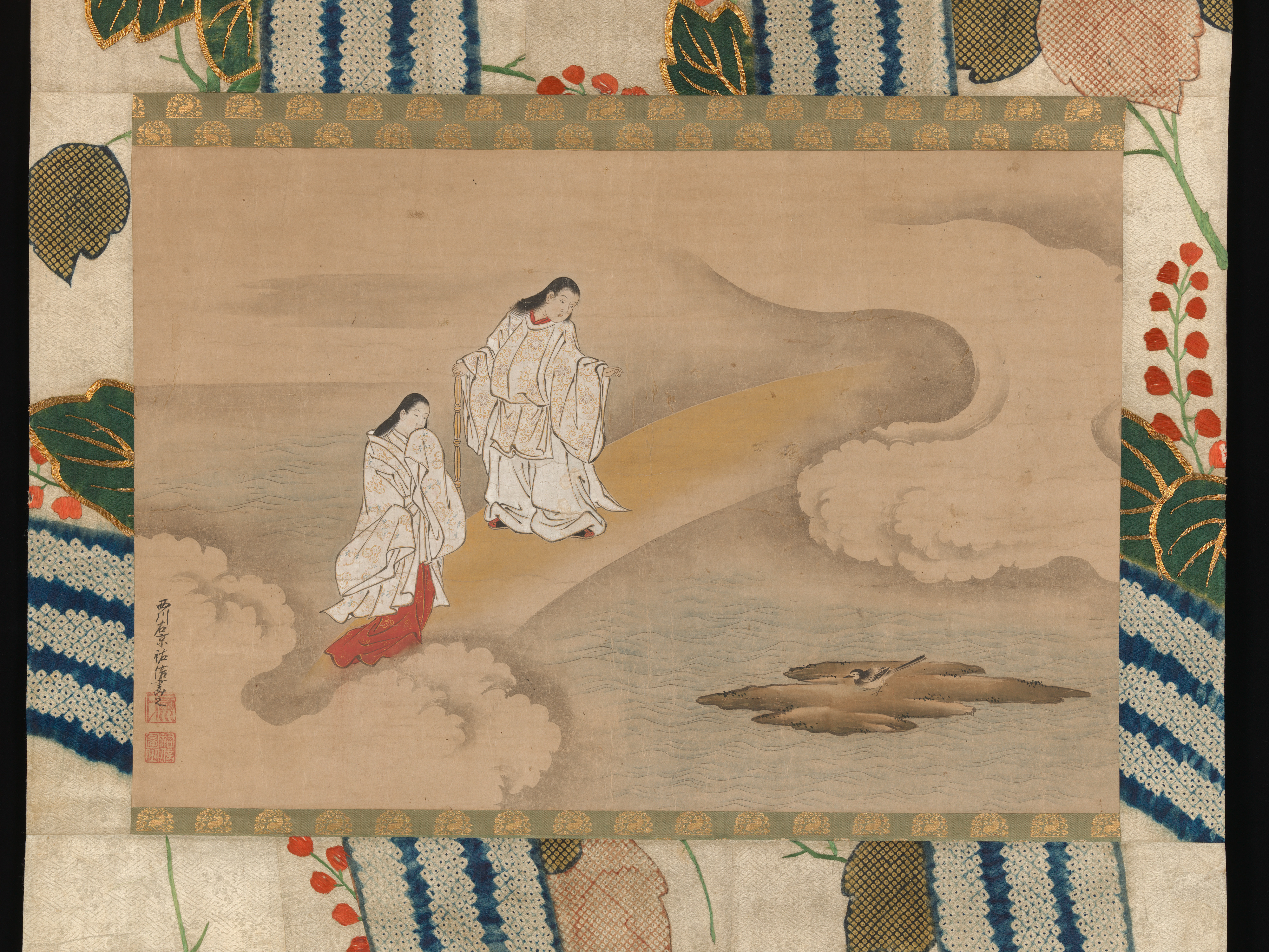
The creator pair Izanagi and Izanami stand on the Floating Bridge of Heaven (Ame-no-ukihashi) and, with the jeweled spear Ame-no-nuhokohe, stir the brine of the deep sea; the salt that drips from the spear forms the first island, Onogoro [S1]S1 · *Kojiki* ('Records of Ancient Matters', 712 CE), trans. Basil Hall Chamberlain (1882/1933) — PRIMARY TRANSLATION — https://sacred-texts.com/Open source ↗. There they wed and, in a series of 'birthings,' produce the great islands of Japan (naming them as they are formed) and then the deities (kami) who attend them [S1]S1 · *Kojiki* ('Records of Ancient Matters', 712 CE), trans. Basil Hall Chamberlain (1882/1933) — PRIMARY TRANSLATION — https://sacred-texts.com/Open source ↗. The sequence of islands and the sequence of kami are given in the text, though the two lists differ between the Kojiki and Nihon Shoki [S1]S1 · *Kojiki* ('Records of Ancient Matters', 712 CE), trans. Basil Hall Chamberlain (1882/1933) — PRIMARY TRANSLATION — https://sacred-texts.com/Open source ↗[S2]S2 · *Nihon Shoki* ('Chronicles of Japan', 720 CE) — PRIMARY TEXT (annalistic + mythographic) — (translation: G. Cameron, 1968; see Internet Arch.

Izanami's Death and the Separation of the World (Izanagi's Purification)

In giving birth to the fire god Kagutsuchi, Izanami is burned and dies [S1]S1 · *Kojiki* ('Records of Ancient Matters', 712 CE), trans. Basil Hall Chamberlain (1882/1933) — PRIMARY TRANSLATION — https://sacred-texts.com/Open source ↗. Izanagi descends to the Land of Yomi to bring her back; finding her decayed and attended by the 'devils of rotting,' he flees, and the two are separated at the threshold—the mythic origin of the divide between the clean world of the living and the polluted realm of the dead [S1]S1 · *Kojiki* ('Records of Ancient Matters', 712 CE), trans. Basil Hall Chamberlain (1882/1933) — PRIMARY TRANSLATION — https://sacred-texts.com/Open source ↗. Fleeing to the world of the living, Izanagi performs a ritual purification (misogi), washing his body; from his washed body-parts a series of kami are born, and the separation is made permanent [S1]S1 · *Kojiki* ('Records of Ancient Matters', 712 CE), trans. Basil Hall Chamberlain (1882/1933) — PRIMARY TRANSLATION — https://sacred-texts.com/Open source ↗. This is the foundational myth of death, impurity (kegare), and purification in Japanese religion [S1]S1 · *Kojiki* ('Records of Ancient Matters', 712 CE), trans. Basil Hall Chamberlain (1882/1933) — PRIMARY TRANSLATION — https://sacred-texts.com/Open source ↗[S2]S2 · *Nihon Shoki* ('Chronicles of Japan', 720 CE) — PRIMARY TEXT (annalistic + mythographic) — (translation: G. Cameron, 1968; see Internet Arch.

The Heavenly Rock-Cave (Amaterasu and the Dark World)

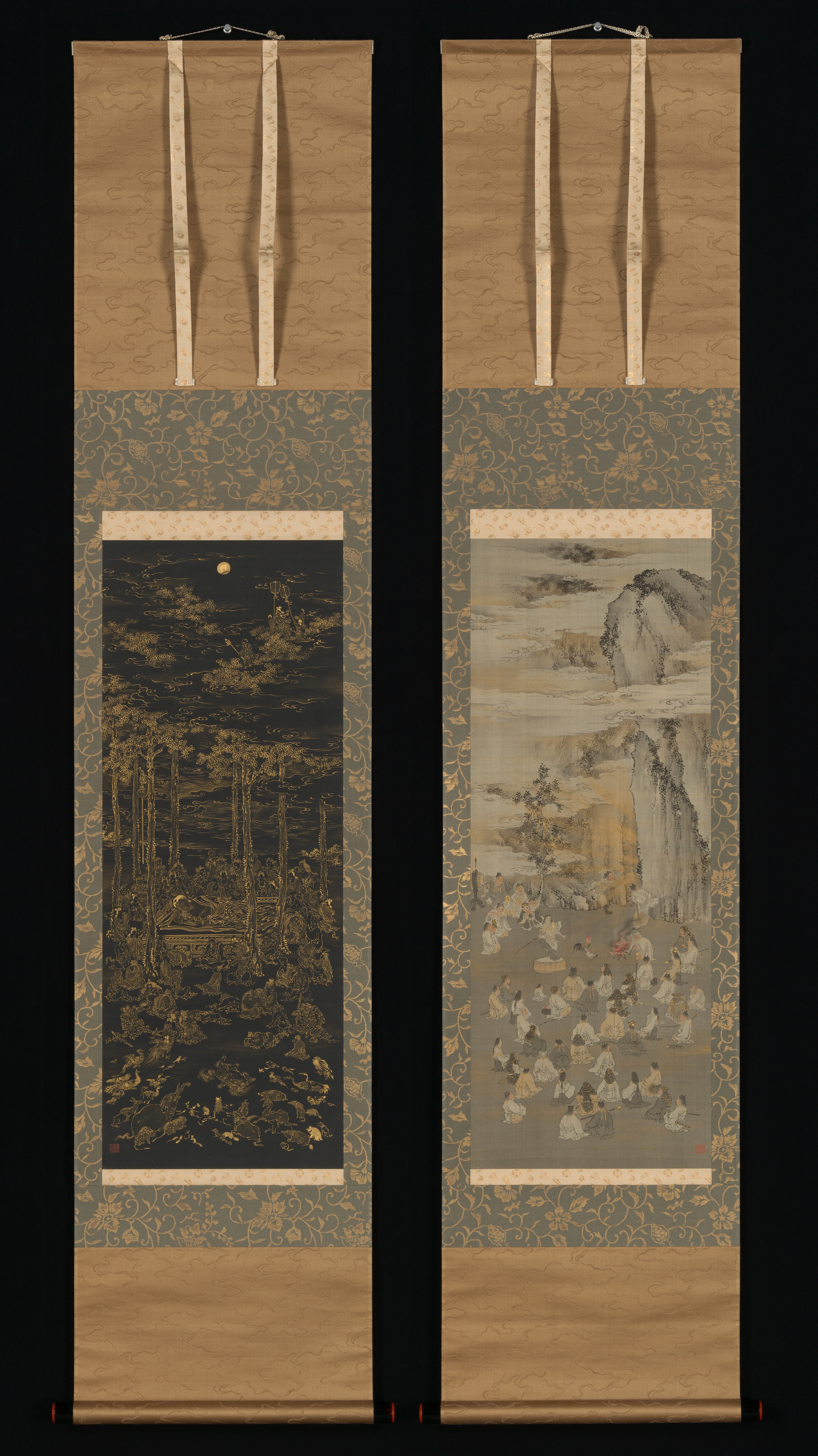
After his brother Susanoo is banished from the High Plain of Heaven for his violent misconduct, Amaterasu, in grief and fear, withdraws into the Heavenly Rock-Cave (Ame-no-Ohafutsu), and the world is plunged into darkness [S1]S1 · *Kojiki* ('Records of Ancient Matters', 712 CE), trans. Basil Hall Chamberlain (1882/1933) — PRIMARY TRANSLATION — https://sacred-texts.com/Open source ↗. The assembled kami devise a plan to lure her out: the goddess Ame-no-Uzume performs a dance (on an upturned tub), and with the clamor of the assembled deities (including the thunder god Takemikazuchi) and a held-out mirror, they provoke Amaterasu's curiosity and joy [S1]S1 · *Kojiki* ('Records of Ancient Matters', 712 CE), trans. Basil Hall Chamberlain (1882/1933) — PRIMARY TRANSLATION — https://sacred-texts.com/Open source ↗. She peers out to see what the commotion is, sees her own radiance in the mirror, and is drawn back into the light, restoring the world [S1]S1 · *Kojiki* ('Records of Ancient Matters', 712 CE), trans. Basil Hall Chamberlain (1882/1933) — PRIMARY TRANSLATION — https://sacred-texts.com/Open source ↗. This is the mythic origin of the kagura (ritual dance) and of the 'luring back of the sun' [S1]S1 · *Kojiki* ('Records of Ancient Matters', 712 CE), trans. Basil Hall Chamberlain (1882/1933) — PRIMARY TRANSLATION — https://sacred-texts.com/Open source ↗[S2]S2 · *Nihon Shoki* ('Chronicles of Japan', 720 CE) — PRIMARY TEXT (annalistic + mythographic) — (translation: G. Cameron, 1968; see Internet Arch.

Susanoo Slayes Yamata-no-Orochi

On his way down from the banished heaven to the earthly realm (Izumo), Susanoo meets the weeping parents of a family whose daughters are being devoured by the eight-headed, eight-tailed serpent Yamata-no-Orochi; seven of the eight daughters have already been eaten, and the last, Kushinada-hime, is next [S1]S1 · *Kojiki* ('Records of Ancient Matters', 712 CE), trans. Basil Hall Chamberlain (1882/1933) — PRIMARY TRANSLATION — https://sacred-texts.com/Open source ↗. Susanoo asks for her hand, turns himself into a hair-comb, and has her wear it in her hair [S1]S1 · *Kojiki* ('Records of Ancient Matters', 712 CE), trans. Basil Hall Chamberlain (1882/1933) — PRIMARY TRANSLATION — https://sacred-texts.com/Open source ↗. He prepares eight vats of sweetened sake and sets out eight cutting-stations; when the serpent drinks and comes to drink, Susanoo slays it, and in its tail he finds the sword Kusanagi (Ame-murakumo-no-tsurugi) [S1]S1 · *Kojiki* ('Records of Ancient Matters', 712 CE), trans. Basil Hall Chamberlain (1882/1933) — PRIMARY TRANSLATION — https://sacred-texts.com/Open source ↗. He rescues Kushinada-hime and marries her [S1]S1 · *Kojiki* ('Records of Ancient Matters', 712 CE), trans. Basil Hall Chamberlain (1882/1933) — PRIMARY TRANSLATION — https://sacred-texts.com/Open source ↗. This is the archetypal Japanese monster-slaying myth and the origin of the sacred sword Kusanagi [S1]S1 · *Kojiki* ('Records of Ancient Matters', 712 CE), trans. Basil Hall Chamberlain (1882/1933) — PRIMARY TRANSLATION — https://sacred-texts.com/Open source ↗[S2]S2 · *Nihon Shoki* ('Chronicles of Japan', 720 CE) — PRIMARY TEXT (annalistic + mythographic) — (translation: G. Cameron, 1968; see Internet Arch.

The Subjugation of the Country (Kuniyurinshi)

When the heavenly prince Ninigi is sent down to rule the middle land, the indigenous island god Ōkuninushi and his retinue (led by the crossroads god Sarutahiko) resist the heavenly takeover [S1]S1 · *Kojiki* ('Records of Ancient Matters', 712 CE), trans. Basil Hall Chamberlain (1882/1933) — PRIMARY TRANSLATION — https://sacred-texts.com/Open source ↗. A contest ensues, centered on the throwing of the sword: the thunder god Takemikazuchi throws the sword (Kusanagi) from the high land to the middle land, hitting the target and demonstrating the heavenly gods' strength [S1]S1 · *Kojiki* ('Records of Ancient Matters', 712 CE), trans. Basil Hall Chamberlain (1882/1933) — PRIMARY TRANSLATION — https://sacred-texts.com/Open source ↗. Sarutahiko, carrying the sword, is subdued, and Ōkuninushi is defeated; he yields the land and hands over the three sacred regalia (mirror, jewel, sword) as pledge [S1]S1 · *Kojiki* ('Records of Ancient Matters', 712 CE), trans. Basil Hall Chamberlain (1882/1933) — PRIMARY TRANSLATION — https://sacred-texts.com/Open source ↗. Thereafter Ōkuninushi becomes a local deity of the earth, healing, and agriculture (especially in Izumo), while the heavenly line takes sovereignty [S1]S1 · *Kojiki* ('Records of Ancient Matters', 712 CE), trans. Basil Hall Chamberlain (1882/1933) — PRIMARY TRANSLATION — https://sacred-texts.com/Open source ↗[S2]S2 · *Nihon Shoki* ('Chronicles of Japan', 720 CE) — PRIMARY TEXT (annalistic + mythographic) — (translation: G. Cameron, 1968; see Internet Arch. This is the mythic foundation of the transfer of rule from the indigenous to the heavenly/imperial line.

The Descent of Ninigi (Tenson Kōryō)

The heavenly prince Ninigi, grandson of Amaterasu, is sent down from Takamagahara to take rule of the middle land (Ashihara-no-Nakatsukuni) [S1]S1 · *Kojiki* ('Records of Ancient Matters', 712 CE), trans. Basil Hall Chamberlain (1882/1933) — PRIMARY TRANSLATION — https://sacred-texts.com/Open source ↗. His descent (Tenson Kōryō) alights at Takachiho in Hyūga (Kyūshū) [S1]S1 · *Kojiki* ('Records of Ancient Matters', 712 CE), trans. Basil Hall Chamberlain (1882/1933) — PRIMARY TRANSLATION — https://sacred-texts.com/Open source ↗. Guided by the crossroads god Sarutahiko, he is confronted by Ōkuninushi's side (the Kuniyurinshi), after which the land is yielded [S1]S1 · *Kojiki* ('Records of Ancient Matters', 712 CE), trans. Basil Hall Chamberlain (1882/1933) — PRIMARY TRANSLATION — https://sacred-texts.com/Open source ↗. Ninigi takes the earthly bride Konohanasakuya-hime and later the heavenly bride Toyotama-hime (Amaterasu's daughter); their son Hooroni (Ōyahata) is the ancestor of the emperors [S1]S1 · *Kojiki* ('Records of Ancient Matters', 712 CE), trans. Basil Hall Chamberlain (1882/1933) — PRIMARY TRANSLATION — https://sacred-texts.com/Open source ↗[S2]S2 · *Nihon Shoki* ('Chronicles of Japan', 720 CE) — PRIMARY TEXT (annalistic + mythographic) — (translation: G. Cameron, 1968; see Internet Arch. The 'birth at sea' of Hooroni (Toyotama-hime giving birth in a hut at sea, whence the sea is born) is part of this descent narrative [S1]S1 · *Kojiki* ('Records of Ancient Matters', 712 CE), trans. Basil Hall Chamberlain (1882/1933) — PRIMARY TRANSLATION — https://sacred-texts.com/Open source ↗.

The Primordial Beginning and the High Plain of Heaven


The High Plain of Heaven

The Kojiki opens in the time when the heavenly high plain (Takamagahara) had just come into being [S1]S1 · *Kojiki* ('Records of Ancient Matters', 712 CE), trans. Basil Hall Chamberlain (1882/1933) — PRIMARY TRANSLATION — https://sacred-texts.com/Open source ↗.

The First-Born

First of all was born the high divine origin of heavenly things, Takamimusubi; his younger brothers Kamimusubi and Aminakanushi follow [S1]S1 · *Kojiki* ('Records of Ancient Matters', 712 CE), trans. Basil Hall Chamberlain (1882/1933) — PRIMARY TRANSLATION — https://sacred-texts.com/Open source ↗.

The Creator Pair

The kami of the high plain 'give birth to' Izanagi and Izanami and order them to shape and settle the earthly islands [S1]S1 · *Kojiki* ('Records of Ancient Matters', 712 CE), trans. Basil Hall Chamberlain (1882/1933) — PRIMARY TRANSLATION — https://sacred-texts.com/Open source ↗.

Variant traditions (2)
Kojiki version

Names the first-born Kamimusubi and the high-plain deities, then the 'birth' of the creator pair and the command to shape the islands.

Nihon Shoki version

A parallel account that phrases the 'birth' of the creator pair as a command/order from the heavenly realm, with different wording and emphasis.

Sources: [S1] [S2]

Izanagi and Izanami Form the Islands


The Floating Bridge

Izanagi and Izanami stand on the Floating Bridge of Heaven (Ame-no-ukihashi) over the brine of the sea [S1]S1 · *Kojiki* ('Records of Ancient Matters', 712 CE), trans. Basil Hall Chamberlain (1882/1933) — PRIMARY TRANSLATION — https://sacred-texts.com/Open source ↗.

The First Island

With the jeweled spear Ame-no-nuhokohe they stir the brine; the dripping salt forms Onogoro, the first island [S1]S1 · *Kojiki* ('Records of Ancient Matters', 712 CE), trans. Basil Hall Chamberlain (1882/1933) — PRIMARY TRANSLATION — https://sacred-texts.com/Open source ↗.

The Islands and the Kami

Over a series of birthings they form the great islands of Japan and give birth to the deities [S1]S1 · *Kojiki* ('Records of Ancient Matters', 712 CE), trans. Basil Hall Chamberlain (1882/1933) — PRIMARY TRANSLATION — https://sacred-texts.com/Open source ↗.

Variant traditions (2)
Kojiki island list

The Kojiki names the islands in a specific order as they are 'born.'

Nihon Shoki island list

The Nihon Shoki gives a related but not identical list and order of the islands.

Sources: [S1] [S2]

Izanami's Death and the Separation of the World (Izanagi's Purification)


The Fire Birth

Izanami, giving birth to the fire god Kagutsuchi, is burned and dies [S1]S1 · *Kojiki* ('Records of Ancient Matters', 712 CE), trans. Basil Hall Chamberlain (1882/1933) — PRIMARY TRANSLATION — https://sacred-texts.com/Open source ↗.

The Descent to Yomi

Izanagi descends to the Land of Yomi to bring her back; he finds her decayed and attended by the 'devils of rotting' [S1]S1 · *Kojiki* ('Records of Ancient Matters', 712 CE), trans. Basil Hall Chamberlain (1882/1933) — PRIMARY TRANSLATION — https://sacred-texts.com/Open source ↗.

The Separation

Izanagi flees; at the threshold the two are separated—the origin of the divide between living and dead [S1]S1 · *Kojiki* ('Records of Ancient Matters', 712 CE), trans. Basil Hall Chamberlain (1882/1933) — PRIMARY TRANSLATION — https://sacred-texts.com/Open source ↗.

The Purification

Izanagi washes himself (misogi); from his washed body-parts a series of kami are born [S1]S1 · *Kojiki* ('Records of Ancient Matters', 712 CE), trans. Basil Hall Chamberlain (1882/1933) — PRIMARY TRANSLATION — https://sacred-texts.com/Open source ↗.

Variant traditions (2)
Kojiki Yomi episode

The full descent, the discovery of decay, the flight, the threshold-separation, and the purification with the birth of kami from the washed body-parts.

Nihon Shoki Yomi episode

A related account with different wording of the descent, the separation point, and the subsequent purification.

Sources: [S1] [S2]

The Heavenly Rock-Cave (Amaterasu and the Dark World)


The Banishment

Susanoo's violent misconduct leads to his banishment from Takamagahara; Amaterasu is grieved and afraid [S1]S1 · *Kojiki* ('Records of Ancient Matters', 712 CE), trans. Basil Hall Chamberlain (1882/1933) — PRIMARY TRANSLATION — https://sacred-texts.com/Open source ↗.

The Withdrawal

Amaterasu withdraws into the Heavenly Rock-Cave, and the world is dark [S1]S1 · *Kojiki* ('Records of Ancient Matters', 712 CE), trans. Basil Hall Chamberlain (1882/1933) — PRIMARY TRANSLATION — https://sacred-texts.com/Open source ↗.

The Dance

Ame-no-Uzume dances on an upturned tub; the assembled deities make a clamor; a mirror is held out [S1]S1 · *Kojiki* ('Records of Ancient Matters', 712 CE), trans. Basil Hall Chamberlain (1882/1933) — PRIMARY TRANSLATION — https://sacred-texts.com/Open source ↗.

The Return of Light

Amaterasu peers out, sees her radiance in the mirror, and is drawn back into the light [S1]S1 · *Kojiki* ('Records of Ancient Matters', 712 CE), trans. Basil Hall Chamberlain (1882/1933) — PRIMARY TRANSLATION — https://sacred-texts.com/Open source ↗.

Variant traditions (2)
Kojiki cave myth

The full account: Susanoo's banishment, Amaterasu's withdrawal, Ame-no-Uzume's dance, the mirror, and the restoration of light.

Nihon Shoki cave myth

A related account with different wording of the roles of the deities, the naming of the cave, and the precise sequence.

Sources: [S1] [S2]

Susanoo Slayes Yamata-no-Orochi


The Weeping Parents

Susanoo meets the weeping parents whose daughters are being devoured by the serpent [S1]S1 · *Kojiki* ('Records of Ancient Matters', 712 CE), trans. Basil Hall Chamberlain (1882/1933) — PRIMARY TRANSLATION — https://sacred-texts.com/Open source ↗.

The Comb

He asks for the last daughter, turns himself into a hair-comb, and has her wear it [S1]S1 · *Kojiki* ('Records of Ancient Matters', 712 CE), trans. Basil Hall Chamberlain (1882/1933) — PRIMARY TRANSLATION — https://sacred-texts.com/Open source ↗.

The Slaying

With eight vats of sweetened sake and cutting-stations, he slays the serpent [S1]S1 · *Kojiki* ('Records of Ancient Matters', 712 CE), trans. Basil Hall Chamberlain (1882/1933) — PRIMARY TRANSLATION — https://sacred-texts.com/Open source ↗.

The Sword and the Bride

In the serpent's tail he finds the sword Kusanagi; he rescues and marries Kushinada-hime [S1]S1 · *Kojiki* ('Records of Ancient Matters', 712 CE), trans. Basil Hall Chamberlain (1882/1933) — PRIMARY TRANSLATION — https://sacred-texts.com/Open source ↗.

Variant traditions (2)
Kojiki Orochi myth

The full account: the weeping parents, the comb, the eight vats of sake, the slaying, and the sword in the tail.

Nihon Shoki Orochi myth

A related account with different wording of the method (the sake, the cutting) and some details.

Sources: [S1] [S2]

The Subjugation of the Country (Kuniyurinshi)


The Resistance

Ōkuninushi and his retinue (led by Sarutahiko) resist the descending heavenly prince [S1]S1 · *Kojiki* ('Records of Ancient Matters', 712 CE), trans. Basil Hall Chamberlain (1882/1933) — PRIMARY TRANSLATION — https://sacred-texts.com/Open source ↗.

The Sword-Throw

Takemikazuchi throws the sword (Kusanagi) from the high land to the middle land, hitting the target [S1]S1 · *Kojiki* ('Records of Ancient Matters', 712 CE), trans. Basil Hall Chamberlain (1882/1933) — PRIMARY TRANSLATION — https://sacred-texts.com/Open source ↗.

The Subduing

Sarutahiko, carrying the sword, is subdued; Ōkuninushi is defeated [S1]S1 · *Kojiki* ('Records of Ancient Matters', 712 CE), trans. Basil Hall Chamberlain (1882/1933) — PRIMARY TRANSLATION — https://sacred-texts.com/Open source ↗.

The Handover

Ōkuninushi yields the land and hands over the three sacred regalia; he becomes a local deity [S1]S1 · *Kojiki* ('Records of Ancient Matters', 712 CE), trans. Basil Hall Chamberlain (1882/1933) — PRIMARY TRANSLATION — https://sacred-texts.com/Open source ↗.

Variant traditions (2)
Kojiki Kuniyurinshi

The full contest: the sword-throw, the subduing of Sarutahiko, the yielding of the land, and the handover of the regalia.

Nihon Shoki Kuniyurinshi

A related account with different wording of the sequence, the role of Kotohikone, and which regalia are handed over.

Sources: [S1] [S2]

The Descent of Ninigi (Tenson Kōryō)


The Descent

Ninigi, grandson of Amaterasu, is sent down to rule the middle land; he alights at Takachiho in Hyūga [S1]S1 · *Kojiki* ('Records of Ancient Matters', 712 CE), trans. Basil Hall Chamberlain (1882/1933) — PRIMARY TRANSLATION — https://sacred-texts.com/Open source ↗.

The Confrontation

Guided by Sarutahiko, he is confronted by Ōkuninushi's side (the Kuniyurinshi); the land is yielded [S1]S1 · *Kojiki* ('Records of Ancient Matters', 712 CE), trans. Basil Hall Chamberlain (1882/1933) — PRIMARY TRANSLATION — https://sacred-texts.com/Open source ↗.

The Brides

Ninigi takes the earthly bride Konohanasakuya-hime and the heavenly bride Toyotama-hime [S1]S1 · *Kojiki* ('Records of Ancient Matters', 712 CE), trans. Basil Hall Chamberlain (1882/1933) — PRIMARY TRANSLATION — https://sacred-texts.com/Open source ↗.

The Birth at Sea

Toyotama-hime gives birth to Hooroni at sea; the sea is born, and the imperial line begins [S1]S1 · *Kojiki* ('Records of Ancient Matters', 712 CE), trans. Basil Hall Chamberlain (1882/1933) — PRIMARY TRANSLATION — https://sacred-texts.com/Open source ↗.

Variant traditions (2)
Kojiki descent

The descent to Takachiho, the Kuniyurinshi, the two brides, and the birth of Hooroni at sea.

Nihon Shoki descent

A related account with the imperial genealogy from Hooroni to Emperor Jimmu, and different wording of the descent.

Sources: [S1] [S2]
04 — Sources & archaeology

When it was written, not when it began


⚠ The date of a source is not the date of the myth it preserves.
ca. 300–550 CE
archaeological
Kofun period (burial mounds)
The Yayoi-Kofun transition; large burial mounds (kofun), haniwa (clay figurines), and bronze mirrors are the archaeological context for the later mythographic tradition [S17]S17 · Tokyo National Museum — MUSEUM (Kofun-period haniwa, bronze mirrors, ritual objects; the archaeological context for the mythographic traditiOpen source ↗.
ca. 400–600 CE
archaeological
Yayoi-Kofun material culture
Iron tools, rice agriculture, and the emerging Yamato polity; the social world in which the kami-cults later codified in the Kojiki took shape [S17]S17 · Tokyo National Museum — MUSEUM (Kofun-period haniwa, bronze mirrors, ritual objects; the archaeological context for the mythographic traditiOpen source ↗[S21]S21 · *Shinto: A Very Short Introduction* — Sue Keown (Oxford UP, 2010) — SCHOLARLY OVERVIEW (for the living-tradition framing and later developme.
712 CE
text
Kojiki compiled
'Records of Ancient Matters,' the earliest Japanese mythographic text, compiled under imperial order [S1]S1 · *Kojiki* ('Records of Ancient Matters', 712 CE), trans. Basil Hall Chamberlain (1882/1933) — PRIMARY TRANSLATION — https://sacred-texts.com/Open source ↗.
720 CE
text
Nihon Shoki compiled
'Chronicles of Japan,' the second major mythographic/annalistic text [S2]S2 · *Nihon Shoki* ('Chronicles of Japan', 720 CE) — PRIMARY TEXT (annalistic + mythographic) — (translation: G. Cameron, 1968; see Internet Arch.
927 CE
text
Engishiki (ritual code)
A Heian-era ritual and administrative code that records shrine rites and the institutional Shinto [S19]S19 · *Engishiki* (ritual/administrative code, 927 CE) — PRIMARY TEXT (institutional Shinto rites).
11th–13th c.
manuscript
Kitano Tenjin illustrated legends
Medieval illustrated (emakimono) accounts of deities and heroes, e.g. the Tenjin (Michizane) legends [S7]S7 · Met Museum: *Illustrated Legends of the Kitano Tenjin Shrine* (late 13th c.) — PUBLIC DOMAIN (Met Open Access) — object 45428.
1600s–1868
manuscript
Shinbutsu-gazurra and Edo-period deity imagery
Printed deity-compendium (shinbutsu-gazurra, e.g. Kanda Genbun's 1720 work) standardizing visual images of the kami [S13]S13 · Kanda Genbun: *Shinbutsu-gazurra* (1720) — Izanagi/Izanami plate — PUBLIC DOMAIN (Wikimedia Commons)[S14]S14 · Kanda Genbun: *Shinbutsu-gazurra* (1720) — Amaterasu plate — PUBLIC DOMAIN (Wikimedia Commons).
1868
modern_recording
Meiji Restoration; state Shinto
The Meiji state separates Shinto from Buddhism and constructs a state Shinto with the imperial line at its center, institutionalizing the Kojiki genealogy [S21]S21 · *Shinto: A Very Short Introduction* — Sue Keown (Oxford UP, 2010) — SCHOLARLY OVERVIEW (for the living-tradition framing and later developme.
1906–1940
modern_recording
Shrine ordinances (jinja rei)
State ordinances codifying shrine ranks and rites, further institutionalizing the mythographic tradition [S21]S21 · *Shinto: A Very Short Introduction* — Sue Keown (Oxford UP, 2010) — SCHOLARLY OVERVIEW (for the living-tradition framing and later developme.
1946
modern_recording
Renunciation of divinity (humanity declaration)
The postwar declaration that the emperor and people are not of a divine origin, marking the end of the official divine-status framing [S21]S21 · *Shinto: A Very Short Introduction* — Sue Keown (Oxford UP, 2010) — SCHOLARLY OVERVIEW (for the living-tradition framing and later developme.

05 — Historical artworks

The visual record


29 pieces, all from open-license or public-domain collections. Attribution is always visible; nothing is scraped.

Amaterasu, Iwato (heavenly rock-cave), Ame-no-Uzume — Luring the Sun Goddess Amaterasu Out of a Cave with Music; Death of the Fire God
Luring the Sun Goddess Amaterasu Out of a Cave with Music; Death of the Fire God · Kōno Bairei · 19th century (Edo/Meiji) · The Metropolitan Museum of Art · Public domain (Met Open Access)
Luring the Sun Goddess Amaterasu Out of a Cave with Music; Death of the Fire God
Amaterasu, Iwato (heavenly rock-cave), Ame-no-Uzume
Amaterasu, Iwato, kagura dance — Amaterasu Emerging from the Cave (Origin of the Iwato Kagura)
Amaterasu Emerging from the Cave (Origin of the Iwato Kagura) · Utagawa Kunisada (Toyokuni III) · 1856 · Wikimedia Commons · Public domain
Amaterasu Emerging from the Cave (Origin of the Iwato Kagura)
Amaterasu, Iwato, kagura dance
Amaterasu — Amaterasu Appearing from the Cave
Amaterasu Appearing from the Cave · Tsukioka Yoshitoshi · c. 1880–1890 (Meiji) · Wikimedia Commons · Public domain
Amaterasu Appearing from the Cave
Amaterasu
Amaterasu — Amaterasu
Amaterasu · Hōen (Taira) Yoshiteru · Meiji period · Wikimedia Commons · Public domain
Amaterasu
Amaterasu
Amaterasu — Amaterasu (from a shinbutsu-zue, 'illustrated compendium of deities')
Amaterasu (from a shinbutsu-zue, 'illustrated compendium of deities') · Anonymous (Emsdo Shinsai, publisher) · 1790 · Wikimedia Commons · Public domain
Amaterasu (from a shinbutsu-zue, 'illustrated compendium of deities')
Amaterasu
Susanoo, Yamata-no-Orochi, Izumo — Susanoo-no-Mikoto Slays Yamata-no-Orochi in Izumo
Susanoo-no-Mikoto Slays Yamata-no-Orochi in Izumo · Tsukioka Yoshitoshi · c. 1880 (Meiji) · Wikimedia Commons · Public domain
Susanoo-no-Mikoto Slays Yamata-no-Orochi in Izumo
Susanoo, Yamata-no-Orochi, Izumo
Susanoo, Yamata-no-Orochi — Dragon: Susanoo-no-Mikoto and the Water Dragon
Dragon: Susanoo-no-Mikoto and the Water Dragon · Utagawa Kuniyoshi · c. 1840s (Edo) · Wikimedia Commons · Public domain
Dragon: Susanoo-no-Mikoto and the Water Dragon
Susanoo, Yamata-no-Orochi
Susanoo, Kushinada-hime — Susanoo Rescues Kushinada-hime
Susanoo Rescues Kushinada-hime · Toyohara Chikanobu · 1886 · Wikimedia Commons · Public domain
Susanoo Rescues Kushinada-hime
Susanoo, Kushinada-hime
Izanagi, Izanami, creation of the islands — Izanagi and Izanami Creating the First Japanese Islands
Izanagi and Izanami Creating the First Japanese Islands · Kobayashi Eitaku · 1880s · Massachusetts Fine Arts (via Wikimedia Commons) · Public domain
Izanagi and Izanami Creating the First Japanese Islands
Izanagi, Izanami, creation of the islands
Izanagi, Izanami — The God Izanagi and Goddess Izanami
The God Izanagi and Goddess Izanami · Nishikawa Sukenobu · c. 1900 (Taishō) · The Metropolitan Museum of Art · Public domain (Met Open Access)
The God Izanagi and Goddess Izanami
Izanagi, Izanami
Izanagi, Izanami — Izanagi and Izanami (from a shinbutsu-zue)
Izanagi and Izanami (from a shinbutsu-zue) · Anonymous (Emsdo Shinsai, publisher) · 1790 · Wikimedia Commons · Public domain
Izanagi and Izanami (from a shinbutsu-zue)
Izanagi, Izanami
Takemikazuchi, shinbutsu-zue (deity portrait compilation) panel — Takemikazuchi
Takemikazuchi · 玉蘭斎貞秀 · undated · Wikimedia Commons (institution in source file) · Public domain
Takemikazuchi
Takemikazuchi, shinbutsu-zue (deity portrait compilation) panel
Takemikazuchi, from Katsushika Hokusai, Ehon Musha-burui (book of warrior portraits) — Takemikazuchi
Takemikazuchi · Katsushika Hokusai · undated · Wikimedia Commons (institution in source file) · Public domain
Takemikazuchi
Takemikazuchi, from Katsushika Hokusai, Ehon Musha-burui (book of warrior portraits)
Takemikazuchi pin, after the 1855 Ansei earthquake namazu (eel-spirit) prints — Takemikazuchi pin
Takemikazuchi pin · Unknown (Edo Period, 1855) · 1855 · Wikimedia Commons (institution in source file) · Public domain
Takemikazuchi pin
Takemikazuchi pin, after the 1855 Ansei earthquake namazu (eel-spirit) prints
Kagutsuchi, shinbutsu-zue panel — Kagutsuchi
Kagutsuchi · 玉蘭斎貞秀 · undated · Wikimedia Commons (institution in source file) · Public domain
Kagutsuchi
Kagutsuchi, shinbutsu-zue panel
Takamimusubi, shinbutsu-zue panel — Takamimusubi
Takamimusubi · 玉蘭斎貞秀 · undated · Wikimedia Commons (institution in source file) · Public domain
Takamimusubi
Takamimusubi, shinbutsu-zue panel
Konohanasakuya-hime, from Hokusai, One Hundred Views of Mount Fuji — Konohanasakuya-hime
Konohanasakuya-hime · Created by Katsushika Hokusai during the Edo period . · undated · Wikimedia Commons (institution in source file) · CC BY-SA 4.0
Konohanasakuya-hime
Konohanasakuya-hime, from Hokusai, One Hundred Views of Mount Fuji
Ninigi, from Ban-motsu Hinagata-e (Otokawa, deity figure compendium) — Ninigi
Ninigi · 音川安親 · undated · Wikimedia Commons (institution in source file) · Public domain
Ninigi
Ninigi, from Ban-motsu Hinagata-e (Otokawa, deity figure compendium)
Toyotama-hime, shinbutsu-zue panel — Toyotama-hime
Toyotama-hime · 玉蘭斎貞秀 · undated · Wikimedia Commons (institution in source file) · Public domain
Toyotama-hime
Toyotama-hime, shinbutsu-zue panel
Hoori meeting Toyotama-hime, the sea-king's daughter — Hoori meeting Toyotama-hime
Hoori meeting Toyotama-hime · Evelyn Paul (artist), F. Hadland Davis (book author) · undated · Wikimedia Commons (institution in source file) · Public domain
Hoori meeting Toyotama-hime
Hoori meeting Toyotama-hime, the sea-king's daughter
Hoori (Ōyahata) meeting the sea-king's daughter — Hoori (Ōyahata) meeting the sea-king's daughter
Hoori (Ōyahata) meeting the sea-king's daughter · Evelyn Paul (artist), F. Hadland Davis (book author) · undated · Wikimedia Commons (institution in source file) · Public domain
Hoori (Ōyahata) meeting the sea-king's daughter
Ōkuninushi no Mikoto statue, Kiyomizu-dera, Kyoto — Ōkuninushi no Mikoto statue
Ōkuninushi no Mikoto statue · Hyppolyte de Saint-Rambert · undated · Wikimedia Commons (institution in source file) · CC BY-SA 4.0
Ōkuninushi no Mikoto statue
Ōkuninushi no Mikoto statue, Kiyomizu-dera, Kyoto
Sarutahiko, shinbutsu-zue panel — Sarutahiko
Sarutahiko · 玉蘭斎貞秀 · undated · Wikimedia Commons (institution in source file) · Public domain
Sarutahiko
Sarutahiko, shinbutsu-zue panel
Sarutahiko and Ame-no-Uzume at the rock-cave, illustration by W. G. Aston — Sarutahiko and Ame-no-Uzume at the rock-cave
Sarutahiko and Ame-no-Uzume at the rock-cave · William George Aston · undated · Wikimedia Commons (institution in source file) · Public domain
Sarutahiko and Ame-no-Uzume at the rock-cave
Sarutahiko and Ame-no-Uzume at the rock-cave, illustration by W. G. Aston
Ame-no-Uzume, shinbutsu-zue panel — Ame-no-Uzume
Ame-no-Uzume · 玉蘭斎貞秀 · undated · Wikimedia Commons (institution in source file) · Public domain
Ame-no-Uzume
Ame-no-Uzume, shinbutsu-zue panel
Ame-no-Uzume with rooster and mirror (Harvard Art Museums print) — Ame-no-Uzume with rooster and mirror (Harvard Art Museums print)
Ame-no-Uzume with rooster and mirror (Harvard Art Museums print) · Unknown · undated · Wikimedia Commons (institution in source file) · Public domain
Ame-no-Uzume with rooster and mirror (Harvard Art Museums print)
Susanoo rescues Kushinada-hime, by Toyohara Chikanobu (1886) — Susanoo rescues Kushinada-hime
Susanoo rescues Kushinada-hime · Toyohara Chikanobu · 1886 · Wikimedia Commons (institution in source file) · Public domain
Susanoo rescues Kushinada-hime
Susanoo rescues Kushinada-hime, by Toyohara Chikanobu (1886)
Susanoo slays Yamata-no-Orochi in Izumo, by Tsukioka Yoshitoshi — Susanoo slays Yamata-no-Orochi in Izumo
Susanoo slays Yamata-no-Orochi in Izumo · Yoshitoshi · 1887 · Wikimedia Commons (institution in source file) · Public domain
Susanoo slays Yamata-no-Orochi in Izumo
Susanoo slays Yamata-no-Orochi in Izumo, by Tsukioka Yoshitoshi
Inari shrine painting by Kawanabe Kyosai — Inari shrine painting by Kawanabe Kyosai
Inari shrine painting by Kawanabe Kyosai · Kawanabe Kyōsai · undated · Wikimedia Commons (institution in source file) · Public domain
Inari shrine painting by Kawanabe Kyosai

06 — Where scholars disagree

Honest uncertainties


We preserve disagreement rather than inventing answers. Each entry lists the competing positions and how this Atlas presents them.

Amaterasu's supremacy

Whether Amaterasu is the single 'supreme' deity or one of several high deities.

Later/medieval view
Amaterasu as the highest deity and ancestress of the emperors (the basis of state Shinto).
Kojiki text
The Kojiki presents her as one of the high deities sent to rule a portion of the realms, not explicitly 'above' all others.

The Rock-Cave myth details

The precise roles of the deities, the naming of the cave, and the role of Takemikazuchi in luring Amaterasu out.

Kojiki version
Ame-no-Uzume's dance, the mirror, and the assembled deities' clamor; specific naming of the cave and deities.
Nihon Shoki version
A related account with different wording and emphasis on the roles.

Ōkuninushi's handover

Whether Ōkuninushi 'yields' the land or is 'subjugated,' and the exact sequence of the Kuniyurinshi contest and the handover of the regalia.

Kojiki version
The sword-throw contest, the subduing of Sarutahiko, and the handover of the three regalia.
Nihon Shoki version
A related account with different wording of the sequence and the role of Kotohikone.

The Yomi-separation details

The details of Izanagi's descent to Yomi, the separation point, and the purification (misogi) with the birth of kami from the washed body-parts.

Kojiki version
The descent, the discovery of decay, the flight, the threshold-separation, and the purification with the birth of kami.
Nihon Shoki version
A related account with different wording of the descent and the purification.

Inari's nature

Inari Ōkami's gender and the identity of the 'foxes' (messengers vs. embodiments), and the deity's precise nature.

Female-deity view
Inari as a female deity of rice and prosperity attended by fox messengers.
Paired/genderless view
Inari as a paired (male-female) or genderless deity; the foxes as embodiments rather than messengers.