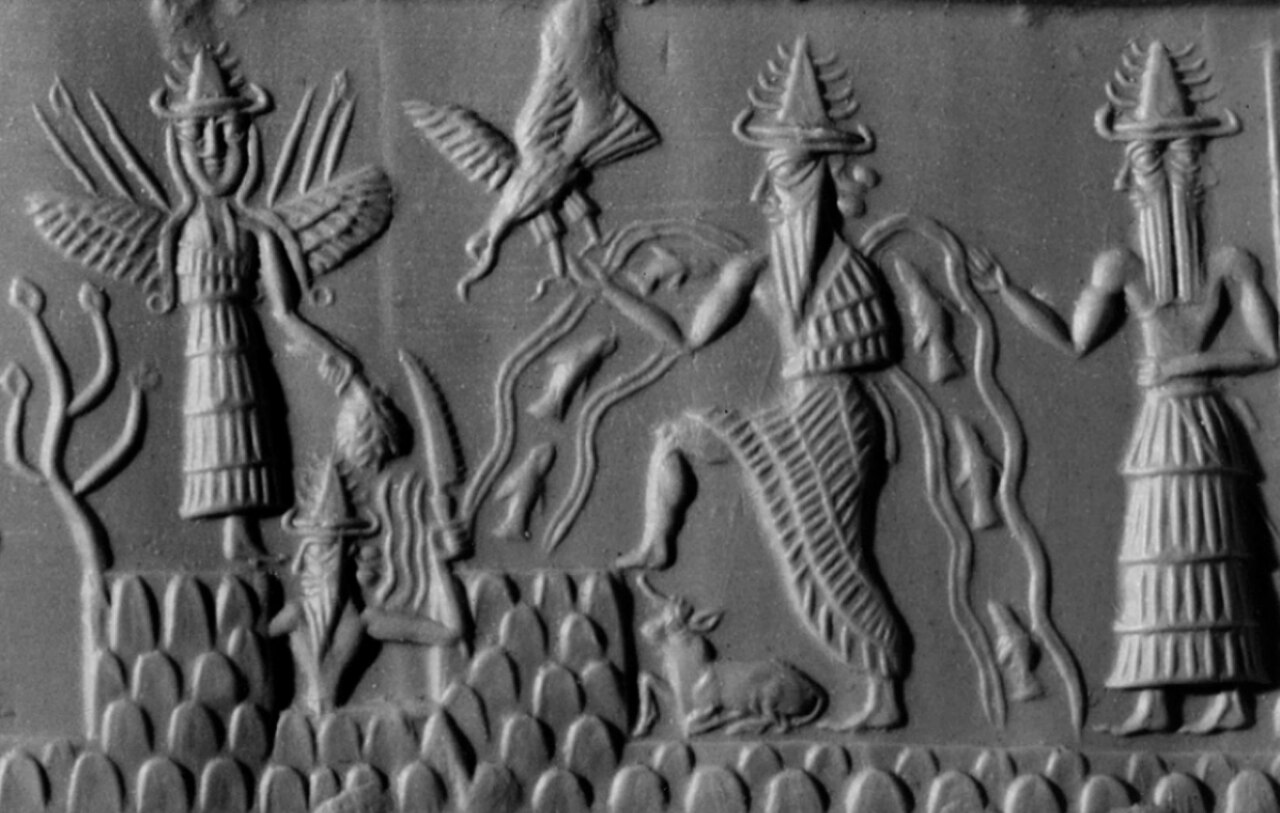
Gallery · c. 2600 BCE – 300 BCE (cuneiform record)

Mesopotamian Mythology

ميثولوجيا بلاد الرافدين
19 entities34 relationships6 myths24 artworks
historical religion

Sumerian, Akkadian, Babylonian, and Assyrian traditions are one layered, continuous religious world. Sumerian names survive inside Akkadian texts; the succession of 'supreme' gods (An → Enlil → Marduk) is presented as political history, not mythic replacement.

01 — Cosmology

The shape of the world


The Mesopotamian cosmos is three-layered: the Heavens (An) above, the Earth (Ki) in the middle, and the Underworld (Irkallu/Kur) below. The 'Apsu' (the fresh water) and the 'Tiamat' (the salt water) are the two primeval waters that underlie the world [S1]S1 · Enuma Elish (Babylonian Creation Epic)Old Babylonian version c. 18th c. BCE; standard form c. 1100-1000 BCEtextOpen source ↗[S5]S5 · etcl.mca.edu — Electronic Text Corpus of cuneiform (transliterations + translations)corpus (Sumerian/Akkadian texts)corpusOpen source ↗. This is a scholarly reconstruction from Sumerian and Babylonian texts [S5]S5 · etcl.mca.edu — Electronic Text Corpus of cuneiform (transliterations + translations)corpus (Sumerian/Akkadian texts)corpusOpen source ↗.


02 — The relationship graph

How the divine world is wired


Two ways to read the same data: the genealogy view layers generations top → bottom (partners side by side, children fanning from the union), while the relationships view shows the full web of typed relationships — filter by category, or click any node to open its profile. Line style encodes confidence: solid = attested, dashed = disputed, dotted = scholarly reconstruction.

View
hierarchical — generations top → bottom, partners side by side
Overlays
MESOPOTAMIAN · 19♥♥♥♥♥Tablets of Dest…Apsu (the primeval …Antu (Anatum)An (the heavens)EreshkigalNergal (Ereshkigal'…Ki (the earth)KinguNergalNingalNinhursagNinlilTiamatEnki (Ea)EnlilMardukNabuNanna (Sin)Inanna (Ishtar)Utu (Shamash)
zoom 1.67× · medium
  • parentage
  • marriage ♥

far = primordials · medium = all · close = detail — scroll/pan, click a deity to focus


03 — Major myths

The stories

The Enuma Elish (the Babylonian Creation Epic)

The Enuma Elish is the great Babylonian creation epic, the 'New Year' (Akitu) festival text. In it, the gods (the 'Apsu' and the 'Tiamat' generations) are in conflict; the young gods (led by Marduk) are chosen to fight Tiamat. Marduk slays Tiamat with his bow, net, and 'rakasu' winds, splits her body in two to make the sky (upper half) and the earth (lower half), and from Kingu's blood (Tiamat's general) creates humanity. Marduk takes the 'Tablet of Destinies' and becomes the king of the gods [S1]S1 · Enuma Elish (Babylonian Creation Epic)Old Babylonian version c. 18th c. BCE; standard form c. 1100-1000 BCEtextOpen source ↗.

The Sumerian Creation (An and Ki)

In Sumerian cosmology, An (the sky) and Ki (the earth) are the first pair — the 'parents' of the world. From their union (or from the separation of heaven and earth), the gods and the world emerge [S5]S5 · etcl.mca.edu — Electronic Text Corpus of cuneiform (transliterations + translations)corpus (Sumerian/Akkadian texts)corpusOpen source ↗. The 'Apsu' (the fresh water) and the 'Tiamat' (the salt water) are the two primeval waters [S5]S5 · etcl.mca.edu — Electronic Text Corpus of cuneiform (transliterations + translations)corpus (Sumerian/Akkadian texts)corpusOpen source ↗.

The Flood (Atrahasis / Gilgamesh)

In the Atrahasis and the Gilgamesh flood-story, the gods (led by Enlil) decide to destroy humanity with a flood (because humanity's noise/disturbance is too great). Enki (Ea) saves the flood-hero (Atrahasis in the Atrahasis; Utnapishtim in the Gilgamesh) by whispering to him to build a boat. The flood destroys all life, but the flood-hero (and his family) survive. The flood-hero is later made immortal (in the Gilgamesh) [S2]S2 · Epic of Gilgamesh (Standard Babylonian version)c. 1200 BCEtextOpen source ↗[S3]S3 · AtrahasisOld Babylonian c. 17th c. BCEtextOpen source ↗.

Inanna's Descent to the Underworld

The great Sumerian myth of 'Inanna's Descent to the Underworld': Inanna descends to the underworld to attend the funeral of her sister Ereshkigal (the underworld-goddess). At the seven gates of the underworld, Inanna is stripped of her powers (her crown, her weapons, her jewelry) one by one. At the bottom, Ereshkigal kills Inanna (she is hung on a peg as a corpse). Enki (the wisdom god) is moved to pity and sends a being (the 'galatur' or the 'keshig') to bring Inanna back. Inanna is restored, but must send a 'stand-in' (her consort Dumuzi) to the underworld in her place [S4]S4 · Inanna's Descent to the Underworldc. 1900-1700 BCE (Sumerian)textOpen source ↗[S5]S5 · etcl.mca.edu — Electronic Text Corpus of cuneiform (transliterations + translations)corpus (Sumerian/Akkadian texts)corpusOpen source ↗.

Inanna and Ereshkigal (the 'sisters' of the underworld)

Inanna (the 'light' goddess) and Ereshkigal (the 'dark' goddess of the underworld) are 'sisters' (in some accounts) or adversaries. The 'Descent' myth is the great conflict between the two: Inanna descends to the underworld and is killed by Ereshkigal [S4]S4 · Inanna's Descent to the Underworldc. 1900-1700 BCE (Sumerian)textOpen source ↗[S5]S5 · etcl.mca.edu — Electronic Text Corpus of cuneiform (transliterations + translations)corpus (Sumerian/Akkadian texts)corpusOpen source ↗. The 'sisters' relationship is a 'light/dark' duality: Inanna is the 'light' (the morning star, the life-giver), Ereshkigal is the 'dark' (the underworld, the death-bringer) [S4]S4 · Inanna's Descent to the Underworldc. 1900-1700 BCE (Sumerian)textOpen source ↗[S5]S5 · etcl.mca.edu — Electronic Text Corpus of cuneiform (transliterations + translations)corpus (Sumerian/Akkadian texts)corpusOpen source ↗.

Enlil and the 'Erosion' of the World (the flood-decree)

In the Atrahasis and the Gilgamesh flood-story, Enlil (the king of the gods) decrees the flood because humanity's noise/disturbance is too great. The 'erosion' of the world (the flood) is Enlil's decree to destroy humanity [S2]S2 · Epic of Gilgamesh (Standard Babylonian version)c. 1200 BCEtextOpen source ↗[S3]S3 · AtrahasisOld Babylonian c. 17th c. BCEtextOpen source ↗. Enki (Ea) saves the flood-hero against Enlil's will [S2]S2 · Epic of Gilgamesh (Standard Babylonian version)c. 1200 BCEtextOpen source ↗[S3]S3 · AtrahasisOld Babylonian c. 17th c. BCEtextOpen source ↗.

The Enuma Elish (the Babylonian Creation Epic)


The Primeval Waters

Apsu (the fresh water) and Tiamat (the salt water) are the two primeval waters [S1]S1 · Enuma Elish (Babylonian Creation Epic)Old Babylonian version c. 18th c. BCE; standard form c. 1100-1000 BCEtextOpen source ↗.

The Conflict

The young gods (led by Marduk) are in conflict with Tiamat's army [S1]S1 · Enuma Elish (Babylonian Creation Epic)Old Babylonian version c. 18th c. BCE; standard form c. 1100-1000 BCEtextOpen source ↗.

Marduk's Challenge

Marduk is chosen to fight Tiamat [S1]S1 · Enuma Elish (Babylonian Creation Epic)Old Babylonian version c. 18th c. BCE; standard form c. 1100-1000 BCEtextOpen source ↗.

The Slaying of Tiamat

Marduk slays Tiamat with his bow, net, and 'rakasu' winds [S1]S1 · Enuma Elish (Babylonian Creation Epic)Old Babylonian version c. 18th c. BCE; standard form c. 1100-1000 BCEtextOpen source ↗.

The Creation of the World

Marduk splits Tiamat's body in two to make the sky and the earth [S1]S1 · Enuma Elish (Babylonian Creation Epic)Old Babylonian version c. 18th c. BCE; standard form c. 1100-1000 BCEtextOpen source ↗.

The Creation of Humanity

From Kingu's blood, Marduk creates humanity [S1]S1 · Enuma Elish (Babylonian Creation Epic)Old Babylonian version c. 18th c. BCE; standard form c. 1100-1000 BCEtextOpen source ↗.

The Tablet of Destinies

Marduk takes the 'Tablet of Destinies' and becomes king of the gods [S1]S1 · Enuma Elish (Babylonian Creation Epic)Old Babylonian version c. 18th c. BCE; standard form c. 1100-1000 BCEtextOpen source ↗.

Variant traditions (1)
Atrahasis (Old Babylonian)

In the Atrahasis, the creation of humanity is from Apsu's flesh (not Kingu's blood); the flood-hero is Atrahasis [S3]S3 · AtrahasisOld Babylonian c. 17th c. BCEtextOpen source ↗.

Sources: [S1]

The Sumerian Creation (An and Ki)


An and Ki

An (the sky) and Ki (the earth) are the first pair [S5]S5 · etcl.mca.edu — Electronic Text Corpus of cuneiform (transliterations + translations)corpus (Sumerian/Akkadian texts)corpusOpen source ↗.

The Primeval Waters

The 'Apsu' (fresh water) and the 'Tiamat' (salt water) are the two primeval waters [S5]S5 · etcl.mca.edu — Electronic Text Corpus of cuneiform (transliterations + translations)corpus (Sumerian/Akkadian texts)corpusOpen source ↗.

The Emergence of the Gods

From the separation of heaven and earth, the gods emerge [S5]S5 · etcl.mca.edu — Electronic Text Corpus of cuneiform (transliterations + translations)corpus (Sumerian/Akkadian texts)corpusOpen source ↗.

Sources: [S5]

The Flood (Atrahasis / Gilgamesh)


The Decision

The gods (led by Enlil) decide to destroy humanity with a flood [S2]S2 · Epic of Gilgamesh (Standard Babylonian version)c. 1200 BCEtextOpen source ↗[S3]S3 · AtrahasisOld Babylonian c. 17th c. BCEtextOpen source ↗.

Enki's Warning

Enki (Ea) whispers to the flood-hero to build a boat [S2]S2 · Epic of Gilgamesh (Standard Babylonian version)c. 1200 BCEtextOpen source ↗[S3]S3 · AtrahasisOld Babylonian c. 17th c. BCEtextOpen source ↗.

The Flood

The flood destroys all life [S2]S2 · Epic of Gilgamesh (Standard Babylonian version)c. 1200 BCEtextOpen source ↗[S3]S3 · AtrahasisOld Babylonian c. 17th c. BCEtextOpen source ↗.

The Survival

The flood-hero (and his family) survive [S2]S2 · Epic of Gilgamesh (Standard Babylonian version)c. 1200 BCEtextOpen source ↗[S3]S3 · AtrahasisOld Babylonian c. 17th c. BCEtextOpen source ↗.

The Immortality

The flood-hero is made immortal (in the Gilgamesh) [S2]S2 · Epic of Gilgamesh (Standard Babylonian version)c. 1200 BCEtextOpen source ↗.

Variant traditions (2)
Gilgamesh (Standard Babylonian)

In the Gilgamesh, the flood-hero is Utnapishtim (the 'faraway' one); the flood is part of Gilgamesh's quest for immortality [S2]S2 · Epic of Gilgamesh (Standard Babylonian version)c. 1200 BCEtextOpen source ↗.

Atrahasis (Old Babylonian)

In the Atrahasis, the flood-hero is Atrahasis; the flood is part of the creation-of-humanity story [S3]S3 · AtrahasisOld Babylonian c. 17th c. BCEtextOpen source ↗.

Sources: [S2] [S3]

Inanna's Descent to the Underworld


The Descent

Inanna descends to the underworld to attend Ereshkigal's funeral [S4]S4 · Inanna's Descent to the Underworldc. 1900-1700 BCE (Sumerian)textOpen source ↗.

The Seven Gates

At the seven gates, Inanna is stripped of her powers one by one [S4]S4 · Inanna's Descent to the Underworldc. 1900-1700 BCE (Sumerian)textOpen source ↗.

The Killing

At the bottom, Ereshkigal kills Inanna (she is hung on a peg) [S4]S4 · Inanna's Descent to the Underworldc. 1900-1700 BCE (Sumerian)textOpen source ↗.

The Restoration

Enki sends a being to bring Inanna back [S4]S4 · Inanna's Descent to the Underworldc. 1900-1700 BCE (Sumerian)textOpen source ↗.

The Stand-in

Inanna must send a 'stand-in' (Dumuzi) to the underworld in her place [S4]S4 · Inanna's Descent to the Underworldc. 1900-1700 BCE (Sumerian)textOpen source ↗.

Variant traditions (1)
Akkadian (Ishtar) version

In the Akkadian (Ishtar) version, the details vary (the 'stand-in' is sometimes not Dumuzi) [S4]S4 · Inanna's Descent to the Underworldc. 1900-1700 BCE (Sumerian)textOpen source ↗.

Sources: [S4] [S5]

Inanna and Ereshkigal (the 'sisters' of the underworld)


The 'Sisters'

Inanna and Ereshkigal are 'sisters' (in some accounts) [S4]S4 · Inanna's Descent to the Underworldc. 1900-1700 BCE (Sumerian)textOpen source ↗[S5]S5 · etcl.mca.edu — Electronic Text Corpus of cuneiform (transliterations + translations)corpus (Sumerian/Akkadian texts)corpusOpen source ↗.

The Light/Dark Duality

Inanna is the 'light'; Ereshkigal is the 'dark' [S4]S4 · Inanna's Descent to the Underworldc. 1900-1700 BCE (Sumerian)textOpen source ↗[S5]S5 · etcl.mca.edu — Electronic Text Corpus of cuneiform (transliterations + translations)corpus (Sumerian/Akkadian texts)corpusOpen source ↗.

The 'Descent'

Inanna descends to the underworld and is killed by Ereshkigal [S4]S4 · Inanna's Descent to the Underworldc. 1900-1700 BCE (Sumerian)textOpen source ↗.

Sources: [S4] [S5]

Enlil and the 'Erosion' of the World (the flood-decree)


The Noise

Humanity's noise/disturbance is too great [S2]S2 · Epic of Gilgamesh (Standard Babylonian version)c. 1200 BCEtextOpen source ↗[S3]S3 · AtrahasisOld Babylonian c. 17th c. BCEtextOpen source ↗.

The Decree

Enlil decrees the flood [S2]S2 · Epic of Gilgamesh (Standard Babylonian version)c. 1200 BCEtextOpen source ↗[S3]S3 · AtrahasisOld Babylonian c. 17th c. BCEtextOpen source ↗.

Enki's Intervention

Enki (Ea) saves the flood-hero against Enlil's will [S2]S2 · Epic of Gilgamesh (Standard Babylonian version)c. 1200 BCEtextOpen source ↗[S3]S3 · AtrahasisOld Babylonian c. 17th c. BCEtextOpen source ↗.

Sources: [S2] [S3]

04 — Sources & archaeology

When it was written, not when it began


⚠ The date of a source is not the date of the myth it preserves.
c. 3500-2000 BCE
period
Sumerian period
The Sumerian period. The gods An, Enlil, Enki, Nanna, Utu, and Inanna are worshipped. The great temples at Nippur (Enlil), Eridu (Enki), Ur (Nanna), and Uruk (Inanna) are built. The evidence is archaeological and cuneiform (Sumerian texts).
c. 2334-2154 BCE
period
Akkadian period
The Akkadian period. The Sumerian gods are assimilated into the Akkadian pantheon (An becomes Anu, Enki becomes Ea, Nanna becomes Sin, Utu becomes Shamash, Inanna becomes Ishtar). Enlil becomes the king of the gods.
c. 2000-1600 BCE
period
Old Babylonian period
The Old Babylonian period. Marduk rises to be the king of the gods (as Babylon rises to power). The Atrahasis and the early flood-stories are composed.
c. 1200-1000 BCE
period
Standard Babylonian period
The Standard Babylonian period. The Enuma Elish (in its standard form) and the Epic of Gilgamesh (in its Standard Babylonian version) are composed. Marduk is the supreme god.
c. 626-330 BCE
period
Neo-Babylonian / Achaemenid period
The Neo-Babylonian and Achaemenid (Persian) period. Marduk is the supreme god (Neo-Babylonian); under the Persians, his supremacy declines. The great temple at Babylon (the Esagila) is still a center of worship.

05 — Historical artworks

The visual record


24 pieces, all from open-license or public-domain collections. Attribution is always visible; nothing is scraped.

Inanna-Ishtar, the sky and love goddess — Inanna/Ishtar, Goddess of the Sky
Inanna/Ishtar, Goddess of the Sky · Unknown (modern illustration) · modern · Wikimedia Commons · CC0
Inanna/Ishtar, Goddess of the Sky
Inanna-Ishtar, the sky and love goddess
The Ishtar Gate, dedicated to the goddess Ishtar — The Ishtar Gate of Babylon
The Ishtar Gate of Babylon · Unknown (Neo-Babylonian craftsmen) · ca. 575 BCE · Wikimedia Commons (Pergamon Museum, Berlin) · Public domain
The Ishtar Gate of Babylon
The Ishtar Gate, dedicated to the goddess Ishtar
A hymn/ritual text of the goddess Ishtar — Hymn to the Goddess Ishtar (clay tablet)
Hymn to the Goddess Ishtar (clay tablet) · Unknown (Babylonian scribe) · 7th–6th century BCE · Wikimedia Commons (Vorderasiatisches Museum, Berlin) · CC BY-SA 4.0
Hymn to the Goddess Ishtar (clay tablet)
A hymn/ritual text of the goddess Ishtar
Marduk slaying Tiamat, the creation battle — Marduk's Battle with Tiamat (from the Enuma Elish)
Marduk's Battle with Tiamat (from the Enuma Elish) · Unknown (modern reconstruction) · modern · Wikimedia Commons · CC BY-SA 4.0
Marduk's Battle with Tiamat (from the Enuma Elish)
Marduk slaying Tiamat, the creation battle
Tablet of the Enuma Elish, the Babylonian creation epic — Enuma Elish clay tablet (tablet IV)
Enuma Elish clay tablet (tablet IV) · Unknown (Babylonian scribe) · ca. 1100 BCE · Wikimedia Commons (British Museum) · CC BY-SA 4.0
Enuma Elish clay tablet (tablet IV)
Tablet of the Enuma Elish, the Babylonian creation epic
A winged goddess — possibly Ishtar or the underworld queen Ereshkigal — The 'Queen of the Night' Relief (Burney Relief)
The 'Queen of the Night' Relief (Burney Relief) · Unknown (Old Babylonian) · 1800–1750 BCE · Wikimedia Commons (British Museum, London) · CC BY-SA 4.0
The 'Queen of the Night' Relief (Burney Relief)
A winged goddess — possibly Ishtar or the underworld queen Ereshkigal
The sun god Shamash in seal iconography — Cylinder Seal of Shamash (Louvre AO 9132)
Cylinder Seal of Shamash (Louvre AO 9132) · Unknown (Mesopotamian seal-cutter) · ca. 2nd millennium BCE · Wikimedia Commons (Louvre, Paris) · Public domain
Cylinder Seal of Shamash (Louvre AO 9132)
The sun god Shamash in seal iconography
Seated statue of Enlil, from Nippur, 1800–1600 BCE, Iraq Museum — Seated statue of Enlil
Seated statue of Enlil · Osama Shukir Muhammed Amin FRCP(Glasg) · 1800 · Iraq Museum, Baghdad · CC BY-SA 4.0
Seated statue of Enlil
Seated statue of Enlil, from Nippur, 1800–1600 BCE, Iraq Museum
Enlil and Ninlil, after a mural from Susa — Enlil and Ninlil
Enlil and Ninlil · Paul Bedson · undated · Louvre Museum · Public domain
Enlil and Ninlil
Enlil and Ninlil, after a mural from Susa
Enki/Ea holding a cup of overflowing water, from Iraq — Enki/Ea holding a cup of overflowing water
Enki/Ea holding a cup of overflowing water · Osama Shukir Muhammed Amin FRCP(Glasg) · undated · The Metropolitan Museum of Art · CC BY-SA 4.0
Enki/Ea holding a cup of overflowing water
Enki/Ea holding a cup of overflowing water, from Iraq
Enki/Ea depiction (Babylonian/Sumerian) — Enki/Ea depiction (Babylonian/Sumerian)
Enki/Ea depiction (Babylonian/Sumerian) · Unknown · undated · Wikimedia Commons (institution in source file) · Public domain
Enki/Ea depiction (Babylonian/Sumerian)
Ninlil, consort of Enlil, after a mural from Susa — Ninlil
Ninlil · Paul Bedson · undated · Louvre Museum · Public domain
Ninlil
Ninlil, consort of Enlil, after a mural from Susa
Bead dedicated to Ninlil by Kurigalzu I or II — Bead dedicated to Ninlil by Kurigalzu I or II
Bead dedicated to Ninlil by Kurigalzu I or II · Babylonian · 1595 · Wikimedia Commons (institution in source file) · CC0
Bead dedicated to Ninlil by Kurigalzu I or II
Votive stele from the temple of Sin (Nanna), Urfa Museum — Votive stele from the temple of Sin (Nanna)
Votive stele from the temple of Sin (Nanna) · Dosseman · undated · Wikimedia Commons (institution in source file) · CC BY-SA 4.0
Votive stele from the temple of Sin (Nanna)
Votive stele from the temple of Sin (Nanna), Urfa Museum
Plaque of Nanna and Ningal, Fitzwilliam Museum — Plaque of Nanna and Ningal
Plaque of Nanna and Ningal · SpeakingArch · undated · Fitzwilliam Museum, Cambridge · CC BY-SA 4.0
Plaque of Nanna and Ningal
Plaque of Nanna and Ningal, Fitzwilliam Museum
Parthian relief of the god Nergal, from Hatra — Parthian relief of the god Nergal
Parthian relief of the god Nergal · Unknown ancient Hatran relief sculptor · undated · Wikimedia Commons (institution in source file) · Public domain
Parthian relief of the god Nergal
Parthian relief of the god Nergal, from Hatra
Nergal symbol, Old-Babylonian fired clay plaque from Nippur — Nergal symbol
Nergal symbol · Osama Shukir Muhammed Amin FRCP(Glasg) · 2003 · Wikimedia Commons (institution in source file) · CC BY-SA 4.0
Nergal symbol
Nergal symbol, Old-Babylonian fired clay plaque from Nippur
Nergal — Ereshkigal's consort — Parthian relief from Hatra — Nergal — Ereshkigal's consort — Parthian relief from Hatra
Nergal — Ereshkigal's consort — Parthian relief from Hatra · Unknown ancient Hatran relief sculptor · undated · Wikimedia Commons (institution in source file) · Public domain
Nergal — Ereshkigal's consort — Parthian relief from Hatra
Marduk's battle with Tiamat, from the Enuma Elish (illustrated edition) — Marduk's battle with Tiamat
Marduk's battle with Tiamat · TYalaA · undated · Wikimedia Commons (institution in source file) · CC BY-SA 4.0
Marduk's battle with Tiamat
Marduk's battle with Tiamat, from the Enuma Elish (illustrated edition)
Colossal statue of Nabu, 8th century BCE, from Nimrud, Iraq Museum — Colossal statue of Nabu
Colossal statue of Nabu · Osama Shukir Muhammed Amin FRCP(Glasg) · undated · Iraq Museum, Baghdad · CC BY-SA 4.0
Colossal statue of Nabu
Colossal statue of Nabu, 8th century BCE, from Nimrud, Iraq Museum
Goddess Bau (Ningal) from Ur, c. 1800 BCE, Iraq Museum — Goddess Bau (Ningal) from Ur
Goddess Bau (Ningal) from Ur · Osama Shukir Muhammed Amin FRCP(Glasg) · 1800 · Iraq Museum, Baghdad · CC BY-SA 4.0
Goddess Bau (Ningal) from Ur
Goddess Bau (Ningal) from Ur, c. 1800 BCE, Iraq Museum
Ningal (moon goddess), plaque with Nanna, Fitzwilliam Museum — Ningal (moon goddess)
Ningal (moon goddess) · SpeakingArch · undated · Fitzwilliam Museum, Cambridge · CC BY-SA 4.0
Ningal (moon goddess)
Ningal (moon goddess), plaque with Nanna, Fitzwilliam Museum
Ninhursag (bull-man with palmtree), ancient relief — Ninhursag (bull-man with palmtree)
Ninhursag (bull-man with palmtree) · Unknown artist Unknown artist · undated · Wikimedia Commons (institution in source file) · Public domain
Ninhursag (bull-man with palmtree)
Ninhursag (bull-man with palmtree), ancient relief
Copper alloy bull from the temple of the goddess Ninhursag, Tell al-Ubaid — Copper alloy bull from the temple of the goddess Ninhursag
Copper alloy bull from the temple of the goddess Ninhursag · Unknown artist Unknown artist · undated · The Metropolitan Museum of Art · CC BY-SA 4.0
Copper alloy bull from the temple of the goddess Ninhursag
Copper alloy bull from the temple of the goddess Ninhursag, Tell al-Ubaid

06 — Where scholars disagree

Honest uncertainties


We preserve disagreement rather than inventing answers. Each entry lists the competing positions and how this Atlas presents them.

The 'supremacy' of the gods over time

Sumerian
An is the supreme god
Akkadian/Babylonian
Enlil is the king of the gods
Babylonian (later)
Marduk is the king of the gods

PRESENTED AS: We present the 'supremacy' as a political/theological development over time, not as a mythic event. We do NOT flatten the pantheon into one 'supreme god'.

Inanna and Ereshkigal

S4
In some accounts they are 'sisters'; in others they are adversaries

PRESENTED AS: We store both versions and note the variation.

The flood-story

Atrahasis
The flood-hero is Atrahasis; the flood is part of the creation-of-humanity story
Gilgamesh
The flood-hero is Utnapishtim; the flood is part of Gilgamesh's quest for immortality

PRESENTED AS: We present both versions (Atrahasis and Gilgamesh) and note the differences.

The 'Descent' myth

Sumerian (c. 1900-1700 BCE)
The 'Descent' in its Sumerian form
Akkadian (Ishtar) version
The details vary (the 'stand-in' is sometimes not Dumuzi)

PRESENTED AS: We present the Sumerian version as the primary and note the Akkadian variant.

The dating of the myths

Sumerian
The Sumerian texts are c. 3500-2000 BCE
Babylonian
The Babylonian texts (Enuma Elish, Gilgamesh) are c. 1800-1000 BCE

PRESENTED AS: We make clear that the Sumerian religion is much older than the Babylonian texts that preserve it.

The 'creation' of humanity

Enuma Elish
From Kingu's blood (Tiamat's general)
Atrahasis
From Apsu's flesh (the primeval fresh water)

PRESENTED AS: We present both versions and note that they are distinct creation-accounts.