Gallery · belief: pre-1000 CE · texts: c. 1220–1270

Norse Mythology

Nordisk mytologi
40 entities80 relationships7 myths27 artworks
historical mythology

The beliefs are pre-Christian (attested archaeologically from the Viking Age); the written sources are Christian-era (1220–1300) and post-hoc. The gap between belief and text is part of what this section presents.

01 — Cosmology

The shape of the world


The Nine Worlds are arranged around the world-tree Yggdrasil, which connects them. Asgard is at the top (the realm of the gods), Midgard (the human world) in the middle, and the realms of ice, fire, and the dead at the bottom and sides. The world-serpent Jörmungandr encircles Midgard in the sea [S2]S2 · Snorri Sturluson, Prose Eddac. 1220–1235textOpen source ↗. Yggdrasil is the axis that holds all the worlds together.


02 — The relationship graph

How the divine world is wired


Two ways to read the same data: the genealogy view layers generations top → bottom (partners side by side, children fanning from the union), while the relationships view shows the full web of typed relationships — filter by category, or click any node to open its profile. Line style encodes confidence: solid = attested, dashed = disputed, dotted = scholarly reconstruction.

View
hierarchical — generations top → bottom, partners side by side
Overlays
NORSE · 40variantvariantvariant♥♥♥♥♥♥BrísingamenGjallarhornDraupnirGungnirSkíðblaðnirMjölnirAngerboagiantthe giantess mother of the monsters4 relationsAuðhumblacreaturethe primordial cow2 relationsBestlagiantthe giantess mother of the gods3 relationsBúrideitythe first god3 relationsFriggdeitymarriage2 relationsGerðrgiantthe giantess beloved of Freyr2 relationsGinnungagaprealmthe void2 relationsHöðrdeitythe blind brother of Baldr4 relationsHrungnirgiantthe giant of the iron head2 relationsJárnsaxa (Járnsaxa)giantthe giantess mother of Thor's sons2 relationsLokitrickstercunning11 relationsMuspel (fire)realmfire0 relationsNannadeitythe wife of Baldr3 relationsNiflheim (ice)realmice0 relationsNjorddeitythe sea3 relationsSídgiantthe giantess who bore Sleipnir (in one accou…2 relationsSifdeitythe wife of Thor2 relationsSkaðideitythe huntress1 relationsSurtgiantthe fire-giant3 relationsTýrdeitywar1 relationsYmirgiantthe primordial giant5 relationsBorrdeitythe ancestor of the gods4 relationsFenrirmonsterthe great wolf8 relationsFreyjadeitylove3 relationsFreyrdeityfertility7 relationsHeldeitythe dead3 relationsJörmungandrmonsterthe world-serpent4 relationsSleipnircreaturethe eight-legged horse of Odin2 relationsOdindeitywisdom15 relationsVédeityone of the three brothers who made the world5 relationsVilideityone of the three brothers who made the world5 relationsBaldrdeitylight10 relationsHeimdalldeitythe watchman3 relationsThordeitythunder10 relationsVálideitythe avenger of Baldr2 relationsVíðarrdeitysilence2 relationsFosite (Forsétir)deitypeace3 relationsMagnideitystrength3 relationsMóðideitystrength4 relationsUllrdeitythe archer1 relations
zoom 3.35× · close
  • parentage
  • marriage ♥

far = primordials · medium = all · close = detail — scroll/pan, click a deity to focus


03 — Major myths

The stories

The Creation of the World from Ymir

Between the ice of Niflheim and the fire of Muspelheim, in the void of Ginnungagap, the rime formed the giant Ymir and the cow Auðhumbla. From the salt Auðhumbla licked came the first god, Búri. His descendants — Odin, Vili, and Vé — killed Ymir and made the world from his body: his blood the seas, his flesh the earth, his bones the mountains, his skull the sky [S2]S2 · Snorri Sturluson, Prose Eddac. 1220–1235textOpen source ↗.

Odin and the Runes

To win the runes, Odin hung himself on the world-tree Yggdrasil for nine nights, pierced by his own spear, until the runes revealed themselves to him [S1]S1 · Poetic Edda (Codex Regius)c. 1270 (preserves earlier oral poetry)textOpen source ↗. The runes are the source of wisdom and of the poetic art, and Odin is their patron [S1]S1 · Poetic Edda (Codex Regius)c. 1270 (preserves earlier oral poetry)textOpen source ↗[S3]S3 · Skaldic poetry (various)9th–13th c. CEtext.

The Death of Baldr

Baldr, the brightest of the gods, had dreams of his death. His mother Frigg extracted oaths from all things not to harm him — except the mistletoe. Loki, disguised as an old woman, learned of this and guided Baldr's blind brother Höðr to throw a mistletoe dart at Baldr, killing him [S2]S2 · Snorri Sturluson, Prose Eddac. 1220–1235textOpen source ↗. Baldr's death is the beginning of the end, setting the chain of events that leads to Ragnarök [S1]S1 · Poetic Edda (Codex Regius)c. 1270 (preserves earlier oral poetry)textOpen source ↗[S2]S2 · Snorri Sturluson, Prose Eddac. 1220–1235textOpen source ↗.

The Binding of Fenrir

The gods, fearing the growing wolf Fenrir, tried to bind him. The first two bindings he broke, but the third — a magic ribbon made of six impossible things (Gleipnir) — held. Only Týr placed his hand in the wolf's mouth as a pledge; when the binding held, Fenrir bit off his hand [S2]S2 · Snorri Sturluson, Prose Eddac. 1220–1235textOpen source ↗.

Loki's Children

Loki, in the form of a mare, mated with the stallion Svaðilfari and bore Sleipnir, the eight-legged horse of Odin. With the giantess Angerboa, Loki fathered the great monsters: the wolf Fenrir, the world-serpent Jörmungandr, and Hel, the ruler of the dead [S2]S2 · Snorri Sturluson, Prose Eddac. 1220–1235textOpen source ↗.

Ragnarök (The Fate of the Gods)

At the end of the world, a great winter (the Fimbulwinter) precedes Ragnarök. The bonds break: Fenrir breaks free, Jörmungandr rises from the sea, and the ship Naglfar (built from the nails of the dead) sails with the hosts of the dead. Heimdall sounds the horn Gjallarhorn; the gods ride to the field of Vígríðr. In the great battle, Odin is swallowed by Fenrir (avenged by Víðarr), Thor slays Jörmungandr but dies of his venom, Freyr is slain by Surt (having given away his sword), and Heimdall and Loki kill each other. Surt's fire destroys the world; from the ashes, a new world rises [S1]S1 · Poetic Edda (Codex Regius)c. 1270 (preserves earlier oral poetry)textOpen source ↗[S2]S2 · Snorri Sturluson, Prose Eddac. 1220–1235textOpen source ↗.

Thor and the Giantess (Geirðröðr)

Thor, disguised as a servant, went to the home of the giantess Geirðröðr to win her as a wife. He lifted the cat (which was actually the world-serpent Jörmungandr in disguise) and drank from a horn that was bottomless (the ocean). He was matched by the giant Utgarda-Pöki, who turned out to be the giant who had been deceiving him with illusions [S2]S2 · Snorri Sturluson, Prose Eddac. 1220–1235textOpen source ↗.

The Creation of the World from Ymir


The Primordial Void

Niflheim (ice), Muspelheim (fire), and the gap between [S2]S2 · Snorri Sturluson, Prose Eddac. 1220–1235textOpen source ↗.

Ymir and Auðhumbla

The rime formed Ymir; the cow licked him free [S2]S2 · Snorri Sturluson, Prose Eddac. 1220–1235textOpen source ↗.

Búri

The first god, from the salt [S2]S2 · Snorri Sturluson, Prose Eddac. 1220–1235textOpen source ↗.

The Three Brothers

Odin, Vili, and Vé, sons of Borr and Bestla [S2]S2 · Snorri Sturluson, Prose Eddac. 1220–1235textOpen source ↗.

The World from Ymir

The body of Ymir became the world [S2]S2 · Snorri Sturluson, Prose Eddac. 1220–1235textOpen source ↗.

Sources: [S1] [S2]

Odin and the Runes


The Self-Sacrifice

Odin hung on Yggdrasil for nine nights [S1]S1 · Poetic Edda (Codex Regius)c. 1270 (preserves earlier oral poetry)textOpen source ↗.

The Reveal

The runes revealed themselves to him [S1]S1 · Poetic Edda (Codex Regius)c. 1270 (preserves earlier oral poetry)textOpen source ↗.

Sources: [S1] [S3]

The Death of Baldr


The Dreams

Baldr dreamed of his death [S2]S2 · Snorri Sturluson, Prose Eddac. 1220–1235textOpen source ↗.

The Oaths

Frigg bound all things — except the mistletoe [S2]S2 · Snorri Sturluson, Prose Eddac. 1220–1235textOpen source ↗.

Loki's Trick

Loki, as an old woman, led Höðr to throw the mistletoe [S2]S2 · Snorri Sturluson, Prose Eddac. 1220–1235textOpen source ↗.

The Death

Baldr was killed; his funeral was a great event [S2]S2 · Snorri Sturluson, Prose Eddac. 1220–1235textOpen source ↗.

Sources: [S2]

The Binding of Fenrir


The Fear

The gods feared Fenrir's strength [S2]S2 · Snorri Sturluson, Prose Eddac. 1220–1235textOpen source ↗.

The First Two Bonds

Leadbond and Dromi — Fenrir broke both [S2]S2 · Snorri Sturluson, Prose Eddac. 1220–1235textOpen source ↗.

Gleipnir

A ribbon of six impossible things [S2]S2 · Snorri Sturluson, Prose Eddac. 1220–1235textOpen source ↗.

Týr's Hand

Only Týr placed his hand in the wolf's mouth; it was bitten off [S2]S2 · Snorri Sturluson, Prose Eddac. 1220–1235textOpen source ↗.

Sources: [S2]

Loki's Children


Sleipnir

Loki as a mare; the eight-legged horse [S2]S2 · Snorri Sturluson, Prose Eddac. 1220–1235textOpen source ↗.

The Monsters

Fenrir, Jörmungandr, and Hel, with Angerboa [S2]S2 · Snorri Sturluson, Prose Eddac. 1220–1235textOpen source ↗.

Sources: [S2]

Ragnarök (The Fate of the Gods)


The Fimbulwinter

Three winters without a summer [S1]S1 · Poetic Edda (Codex Regius)c. 1270 (preserves earlier oral poetry)textOpen source ↗[S2]S2 · Snorri Sturluson, Prose Eddac. 1220–1235textOpen source ↗.

The Breaking of Bonds

Fenrir, Jörmungandr, and the dead are released [S1]S1 · Poetic Edda (Codex Regius)c. 1270 (preserves earlier oral poetry)textOpen source ↗[S2]S2 · Snorri Sturluson, Prose Eddac. 1220–1235textOpen source ↗.

The Horn

Heimdall sounds Gjallarhorn [S1]S1 · Poetic Edda (Codex Regius)c. 1270 (preserves earlier oral poetry)textOpen source ↗[S2]S2 · Snorri Sturluson, Prose Eddac. 1220–1235textOpen source ↗.

The Battle

The gods ride to Vígríðr; the great killing [S1]S1 · Poetic Edda (Codex Regius)c. 1270 (preserves earlier oral poetry)textOpen source ↗[S2]S2 · Snorri Sturluson, Prose Eddac. 1220–1235textOpen source ↗.

The Fire

Surt's fire destroys the world [S1]S1 · Poetic Edda (Codex Regius)c. 1270 (preserves earlier oral poetry)textOpen source ↗[S2]S2 · Snorri Sturluson, Prose Eddac. 1220–1235textOpen source ↗.

The New World

From the ashes, a new world rises [S1]S1 · Poetic Edda (Codex Regius)c. 1270 (preserves earlier oral poetry)textOpen source ↗[S2]S2 · Snorri Sturluson, Prose Eddac. 1220–1235textOpen source ↗.

Sources: [S1] [S2]

Thor and the Giantess (Geirðröðr)


The Disguise

Thor as a servant [S2]S2 · Snorri Sturluson, Prose Eddac. 1220–1235textOpen source ↗.

The Cat

Lifting the cat (Jörmungandr in disguise) [S2]S2 · Snorri Sturluson, Prose Eddac. 1220–1235textOpen source ↗.

The Horn

Drinking from the bottomless horn (the ocean) [S2]S2 · Snorri Sturluson, Prose Eddac. 1220–1235textOpen source ↗.

The Reveal

Utgarda-Pöki's illusions revealed [S2]S2 · Snorri Sturluson, Prose Eddac. 1220–1235textOpen source ↗.

Sources: [S2]

04 — Sources & archaeology

When it was written, not when it began


⚠ The date of a source is not the date of the myth it preserves.
c. 500–800 CE
period
Proto-Norse
The Norse gods are worshipped in Scandinavia; the earliest evidence is archaeological (runestones, offerings, place-names). The gods Odin, Thor, and others are named.
c. 793–1066 CE
period
Viking Age
The Viking Age. Skaldic poetry names the gods. The great ship burials (Oseberg, c. 834; Gokstad) and the Gosforth Cross (c. 950–1000) show the gods in art.
c. 1000–1100 CE
period
Conversion
Scandinavia converts to Christianity; the old gods are suppressed but survive in poetry and place-names.
c. 1220–1235 CE
period
Snorri Sturluson
Snorri Sturluson writes the Prose Edda, preserving the myths in a Christian context. This is the main source for most Norse myth.
c. 1270 CE (preserves 9th–11th c. poetry)
period
Poetic Edda
The Poetic Edda (Codex Regius) is copied, preserving older oral poetry (the Hávamál, the Völuspá, and others).

05 — Historical artworks

The visual record


27 pieces, all from open-license or public-domain collections. Attribution is always visible; nothing is scraped.

Odin as Allfather with ravens and wolves — Odin, der Göttervater (Odin, the Father of the Gods)
Odin, der Göttervater (Odin, the Father of the Gods) · Carl Emil Doepler · c. 1890 · Romantic-era illustration (widely reproduced) · Public domain
Odin, der Göttervater (Odin, the Father of the Gods)
Odin as Allfather with ravens and wolves
Odin riding the eight-legged horse Sleipnir — Odin on Sleipnir (17th-c. Icelandic manuscript)
Odin on Sleipnir (17th-c. Icelandic manuscript) · Unknown (Icelandic manuscript illuminator) · 1667 · National Library of Iceland (Háskólabibliótekin), MS Neustadt 97 · Public domain
Odin on Sleipnir (17th-c. Icelandic manuscript)
Odin riding the eight-legged horse Sleipnir
Viking-age royal ship burial (archaeological) — The Oseberg Ship
The Oseberg Ship · Unknown (Viking craftsmen) · c. 820 CE · Viking Ship Museum, Oslo (Vikingskipshuset) · Public domain
The Oseberg Ship
Viking-age royal ship burial (archaeological)
Thor fighting the giants — Thor's Battle Against the Jötnar
Thor's Battle Against the Jötnar · Mårten Eskil Winge · 1872 · National Museum, Stockholm · Public domain
Thor's Battle Against the Jötnar
Thor fighting the giants
Thor striking the giant Hrungnir with Mjölnir — Thor and Hrungnir
Thor and Hrungnir · Ludwig Pietsch · c. 1900 · German mythological illustration · Public domain
Thor and Hrungnir
Thor striking the giant Hrungnir with Mjölnir
Thor, god of thunder — Thor (Valhalla)
Thor (Valhalla) · Johannes Gehrts · c. 1900 · German mythological illustration · Public domain
Thor (Valhalla)
Thor, god of thunder
Baldr's death — The Death of Balder (Balders Død)
The Death of Balder (Balders Død) · Peter Cramer · 1779 · Danish rococo painting · Public domain
The Death of Balder (Balders Død)
Baldr's death
Loki, the trickster — Loki leaves the hall and threatens the Æsir with fire
Loki leaves the hall and threatens the Æsir with fire · Christian Frølich · c. 1900 · Danish mythological illustration · Public domain
Loki leaves the hall and threatens the Æsir with fire
Loki, the trickster
Viking-age ship burial (archaeological) — The Gokstad Ship
The Gokstad Ship · Unknown (Viking craftsmen) · c. 890 CE · Viking Ship Museum, Oslo (Vikingskipshuset) · CC BY-SA 3.0
The Gokstad Ship
Viking-age ship burial (archaeological)
Freyja with the necklace Brísingamen — Freyja and the Necklace (Brísingamen)
Freyja and the Necklace (Brísingamen) · James Doyle Penrose · 1890 · British romantic-era illustration · Public domain
Freyja and the Necklace (Brísingamen)
Freyja with the necklace Brísingamen
Hel, ruler of the realm of the dead — Hel
Hel · Natalia Zarubina · early 20th c. · Russian symbolist painting · CC BY-SA 4.0
Hel
Hel, ruler of the realm of the dead
Odin confronting the wolf Fenrir — Odin and Fenris
Odin and Fenris · Mabel Dorothy Hardy · c. 1910 · British illustration · Public domain
Odin and Fenris
Odin confronting the wolf Fenrir
Tyr and Fenrir, by John Bauer (for Our Fathers' Godsaga) — Tyr and Fenrir
Tyr and Fenrir · John Bauer · undated · Wikimedia Commons (institution in source file) · Public domain
Tyr and Fenrir
Tyr and Fenrir, by John Bauer (for Our Fathers' Godsaga)
Höðr, guided by Loki, shoots the mistletoe at Baldr, by Doepler — Höðr
Höðr · Carl Emil Doepler (1824-1905) · undated · Wikimedia Commons (institution in source file) · Public domain
Höðr
Höðr, guided by Loki, shoots the mistletoe at Baldr, by Doepler
Víðarr, by Mårten Winge (Hansen): the god straps on his shoe — Víðarr
Víðarr · Xylograph by Hans Christian Henneberg (1826-93) based on a work by Constantin Hansen (1… · undated · Wikimedia Commons (institution in source file) · Public domain
Víðarr
Víðarr, by Mårten Winge (Hansen): the god straps on his shoe
Víðarr in the jaws of Fenrir, by J. R. Collingwood — Víðarr in the jaws of Fenrir
Víðarr in the jaws of Fenrir · W.G. Collingwood (1854 - 1932) · undated · Wikimedia Commons (institution in source file) · Public domain
Víðarr in the jaws of Fenrir
Víðarr in the jaws of Fenrir, by J. R. Collingwood
Vidar, by Lindboe/Hansen — Vidar
Vidar · Unknown (Norsk Folkemuseum) · undated · Wikimedia Commons (institution in source file) · Public domain
Vidar
Vidar, by Lindboe/Hansen
Sif, by E. Dollman (Edda illustration) — Sif
Sif · John Charles Dollman · 1995 · Wikimedia Commons (institution in source file) · Public domain
Sif
Sif, by E. Dollman (Edda illustration)
"Sif was Queen of the Fields" — the goddess with golden hair — "Sif was Queen of the Fields" — the goddess with golden hair
"Sif was Queen of the Fields" — the goddess with golden hair · Unknown author Unknown author · undated · Wikimedia Commons (institution in source file) · Public domain
"Sif was Queen of the Fields" — the goddess with golden hair
Loki and Sif, by A. Chase — Loki and Sif
Loki and Sif · Credited to A. Chase (title page) · undated · Wikimedia Commons (institution in source file) · Public domain
Loki and Sif
Loki and Sif, by A. Chase
Wooden statue of Heimdall, unveiled at Midgardsblot 2023 — Wooden statue of Heimdall
Wooden statue of Heimdall · Birgit Fostervold · 2023 · Wikimedia Commons (institution in source file) · CC BY-SA 4.0
Wooden statue of Heimdall
Wooden statue of Heimdall, unveiled at Midgardsblot 2023
Ullr, illustration from manuscript AM 738 4to — Ullr
Ullr · Unknown author Unknown author · undated · Wikimedia Commons (institution in source file) · Public domain
Ullr
Ullr, illustration from manuscript AM 738 4to
"Forseti zu Gericht sitzend" — Forseti sitting in judgement — "Forseti zu Gericht sitzend" — Forseti sitting in judgement
"Forseti zu Gericht sitzend" — Forseti sitting in judgement · Carl Emil Doepler (1824-1905) · undated · Wikimedia Commons (institution in source file) · Public domain
"Forseti zu Gericht sitzend" — Forseti sitting in judgement
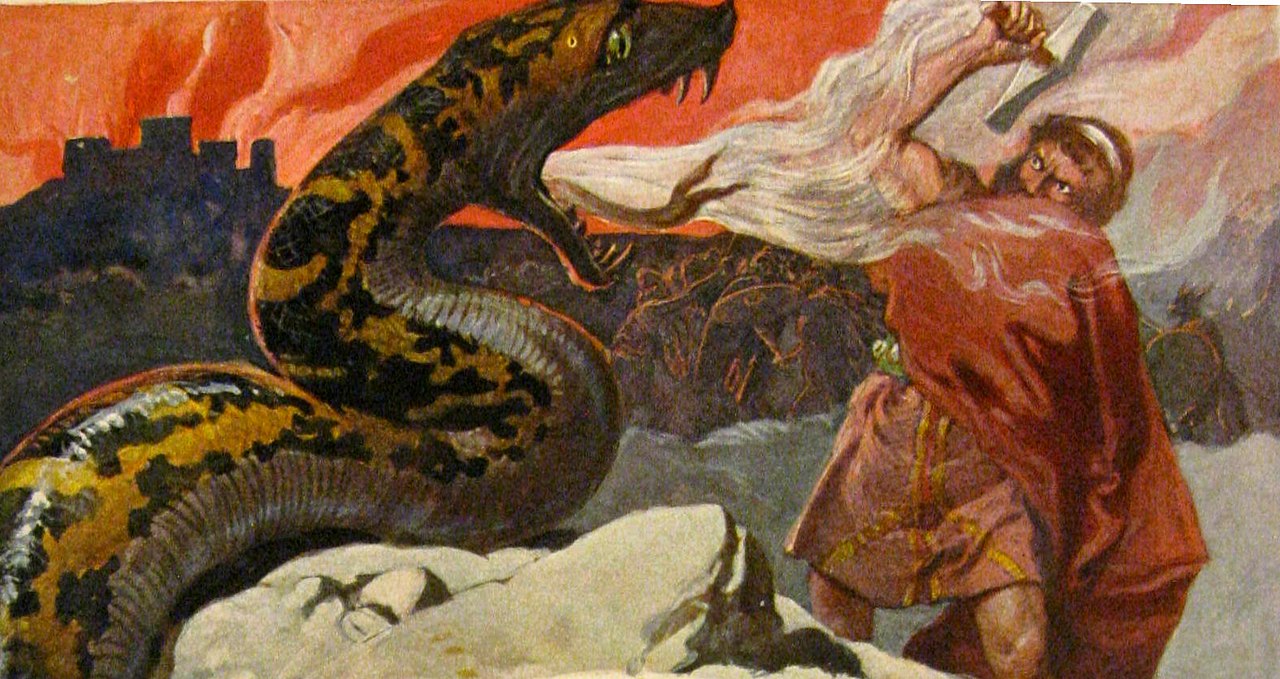
Thor and the Midgard Serpent (Jörmungandr), Ragnarök scene — Thor and the Midgard Serpent (Jörmungandr)
Thor and the Midgard Serpent (Jörmungandr) · Emil Doepler · undated · Wikimedia Commons (institution in source file) · Public domain
Thor and the Midgard Serpent (Jörmungandr)
Thor and the Midgard Serpent (Jörmungandr), Ragnarök scene
Thor, Hymir and the Midgard Serpent — Thor
Thor · Lorenz Frølich · undated · Wikimedia Commons (institution in source file) · Public domain
Thor
Thor, Hymir and the Midgard Serpent
Jörmungandr (world-serpent) illustration — Jörmungandr (world-serpent) illustration
Jörmungandr (world-serpent) illustration · Unknown · undated · Wikimedia Commons (institution in source file) · Public domain
Jörmungandr (world-serpent) illustration
Freyr and Surt do battle at Ragnarök, by Frølich — Freyr and Surt do battle at Ragnarök
Freyr and Surt do battle at Ragnarök · Lorenz Frølich · undated · Wikimedia Commons (institution in source file) · Public domain
Freyr and Surt do battle at Ragnarök
Freyr and Surt do battle at Ragnarök, by Frølich

06 — Where scholars disagree

Honest uncertainties


We preserve disagreement rather than inventing answers. Each entry lists the competing positions and how this Atlas presents them.

Thor's parentage

S2 (Prose Edda)
Son of Odin and the giantess Járnsaxa (or the earth Jörd)
Other
Some accounts give different mothers

PRESENTED AS: We note the variant; the core is that Thor is the son of Odin.

Heimdall's parentage

S2
Son of Odin and Angrboða (odd, since she is elsewhere Loki's wife)
Other
Nine mothers

PRESENTED AS: Both variants stored; the sources are not consistent.

Ullr's parentage

S2
Son of Thor and Sif
Other
Son of the giant Trúðr

PRESENTED AS: Both variants stored.

The Æsir vs. the Vanir

S2
Two separate divine tribes who later merge
Interpretive
Some scholars see the 'two tribes' as a later literary construction

PRESENTED AS: We present the 'two tribes' as the sources present it, and note the scholarly interpretation separately.

The dating of the myths

Archaeological
The gods are worshipped from at least the 5th–8th c. CE (place-names, runestones)
Literary
The main sources (Eddas) are 13th c. CE

PRESENTED AS: We make clear that the 13th-c. texts preserve older oral traditions; the worship is much older than the texts.

Loki's status

S2
'Blood-related' to the gods but not a true Æsir; a giant/trickster
Interpretive
Some scholars see Loki as a 'chthonic' or 'liminal' figure

PRESENTED AS: We present Loki as the sources do (not a true Æsir) and note the interpretation.