Story · Japanese Mythology · 4 chapters

The Heavenly Rock-Cave (Amaterasu and the Dark World)

After his brother Susanoo is banished from the High Plain of Heaven for his violent misconduct, Amaterasu, in grief and fear, withdraws into the Heavenly Rock-Cave (Ame-no-Ohafutsu), and the world is plunged into darkness [S1]S1 · *Kojiki* ('Records of Ancient Matters', 712 CE), trans. Basil Hall Chamberlain (1882/1933) — PRIMARY TRANSLATION — https://sacred-texts.com/Open source ↗. The assembled kami devise a plan to lure her out: the goddess Ame-no-Uzume performs a dance (on an upturned tub), and with the clamor of the assembled deities (including the thunder god Takemikazuchi) and a held-out mirror, they provoke Amaterasu's curiosity and joy [S1]S1 · *Kojiki* ('Records of Ancient Matters', 712 CE), trans. Basil Hall Chamberlain (1882/1933) — PRIMARY TRANSLATION — https://sacred-texts.com/Open source ↗. She peers out to see what the commotion is, sees her own radiance in the mirror, and is drawn back into the light, restoring the world [S1]S1 · *Kojiki* ('Records of Ancient Matters', 712 CE), trans. Basil Hall Chamberlain (1882/1933) — PRIMARY TRANSLATION — https://sacred-texts.com/Open source ↗. This is the mythic origin of the kagura (ritual dance) and of the 'luring back of the sun' [S1]S1 · *Kojiki* ('Records of Ancient Matters', 712 CE), trans. Basil Hall Chamberlain (1882/1933) — PRIMARY TRANSLATION — https://sacred-texts.com/Open source ↗[S2]S2 · *Nihon Shoki* ('Chronicles of Japan', 720 CE) — PRIMARY TEXT (annalistic + mythographic) — (translation: G. Cameron, 1968; see Internet Arch.

living religious tradition

Shinto is a living religious tradition. These narratives are presented as the tradition's own mythic heritage, with the historical layers (Kojiki 712 CE, Nihon Shoki 720 CE, shrine engi) made visible. Modern state-Sinto and pop-culture readings are labeled separately from the primary texts.
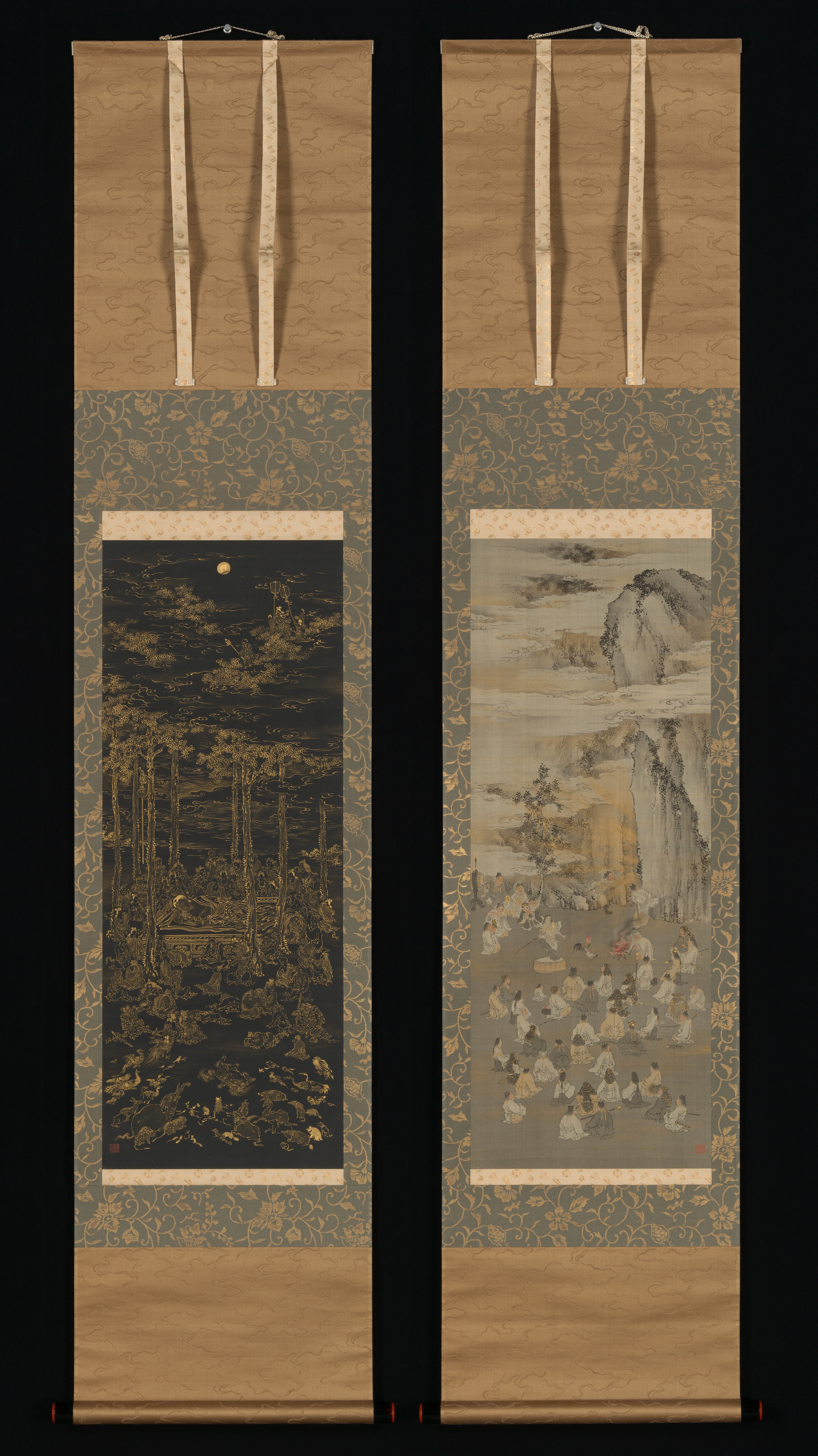
Amaterasu, Iwato (heavenly rock-cave), Ame-no-Uzume — Luring the Sun Goddess Amaterasu Out of a Cave with Music; Death of the Fire God
Luring the Sun Goddess Amaterasu Out of a Cave with Music; Death of the Fire God · Kōno Bairei · 19th century (Edo/Meiji) · The Metropolitan Museum of Art · Public domain (Met Open Access)
⚠ Scholars disagree

The precise roles of each deity in the cave myth, the naming of the cave, and the role of Takemikazuchi differ between the Kojiki and Nihon Shoki [S1]S1 · *Kojiki* ('Records of Ancient Matters', 712 CE), trans. Basil Hall Chamberlain (1882/1933) — PRIMARY TRANSLATION — https://sacred-texts.com/Open source ↗[S2]S2 · *Nihon Shoki* ('Chronicles of Japan', 720 CE) — PRIMARY TEXT (annalistic + mythographic) — (translation: G. Cameron, 1968; see Internet Arch.

CHAPTER 01

The Banishment

Susanoo's violent misconduct leads to his banishment from Takamagahara; Amaterasu is grieved and afraid [S1]S1 · *Kojiki* ('Records of Ancient Matters', 712 CE), trans. Basil Hall Chamberlain (1882/1933) — PRIMARY TRANSLATION — https://sacred-texts.com/Open source ↗.
Sources[S1]S1 · *Kojiki* ('Records of Ancient Matters', 712 CE), trans. Basil Hall Chamberlain (1882/1933) — PRIMARY TRANSLATION — https://sacred-texts.com/Open source ↗
Amaterasu, Iwato, kagura dance — Amaterasu Emerging from the Cave (Origin of the Iwato Kagura)
Amaterasu Emerging from the Cave (Origin of the Iwato Kagura) · Utagawa Kunisada (Toyokuni III) · 1856 · Wikimedia Commons · Public domain
CHAPTER 02

The Withdrawal

Amaterasu withdraws into the Heavenly Rock-Cave, and the world is dark [S1]S1 · *Kojiki* ('Records of Ancient Matters', 712 CE), trans. Basil Hall Chamberlain (1882/1933) — PRIMARY TRANSLATION — https://sacred-texts.com/Open source ↗.
Sources[S1]S1 · *Kojiki* ('Records of Ancient Matters', 712 CE), trans. Basil Hall Chamberlain (1882/1933) — PRIMARY TRANSLATION — https://sacred-texts.com/Open source ↗
CHAPTER 03

The Dance

Ame-no-Uzume dances on an upturned tub; the assembled deities make a clamor; a mirror is held out [S1]S1 · *Kojiki* ('Records of Ancient Matters', 712 CE), trans. Basil Hall Chamberlain (1882/1933) — PRIMARY TRANSLATION — https://sacred-texts.com/Open source ↗.
Sources[S1]S1 · *Kojiki* ('Records of Ancient Matters', 712 CE), trans. Basil Hall Chamberlain (1882/1933) — PRIMARY TRANSLATION — https://sacred-texts.com/Open source ↗
CHAPTER 04

The Return of Light

Amaterasu peers out, sees her radiance in the mirror, and is drawn back into the light [S1]S1 · *Kojiki* ('Records of Ancient Matters', 712 CE), trans. Basil Hall Chamberlain (1882/1933) — PRIMARY TRANSLATION — https://sacred-texts.com/Open source ↗.
Sources[S1]S1 · *Kojiki* ('Records of Ancient Matters', 712 CE), trans. Basil Hall Chamberlain (1882/1933) — PRIMARY TRANSLATION — https://sacred-texts.com/Open source ↗
Amaterasu — Amaterasu Appearing from the Cave
Amaterasu Appearing from the Cave · Tsukioka Yoshitoshi · c. 1880–1890 (Meiji) · Wikimedia Commons · Public domain
Variants of this story (2)
Kojiki cave myth

The full account: Susanoo's banishment, Amaterasu's withdrawal, Ame-no-Uzume's dance, the mirror, and the restoration of light.

Nihon Shoki cave myth

A related account with different wording of the roles of the deities, the naming of the cave, and the precise sequence.

Primary sources[S1]S1 · *Kojiki* ('Records of Ancient Matters', 712 CE), trans. Basil Hall Chamberlain (1882/1933) — PRIMARY TRANSLATION — https://sacred-texts.com/Open source ↗ [S2]S2 · *Nihon Shoki* ('Chronicles of Japan', 720 CE) — PRIMARY TEXT (annalistic + mythographic) — (translation: G. Cameron, 1968; see Internet Arch