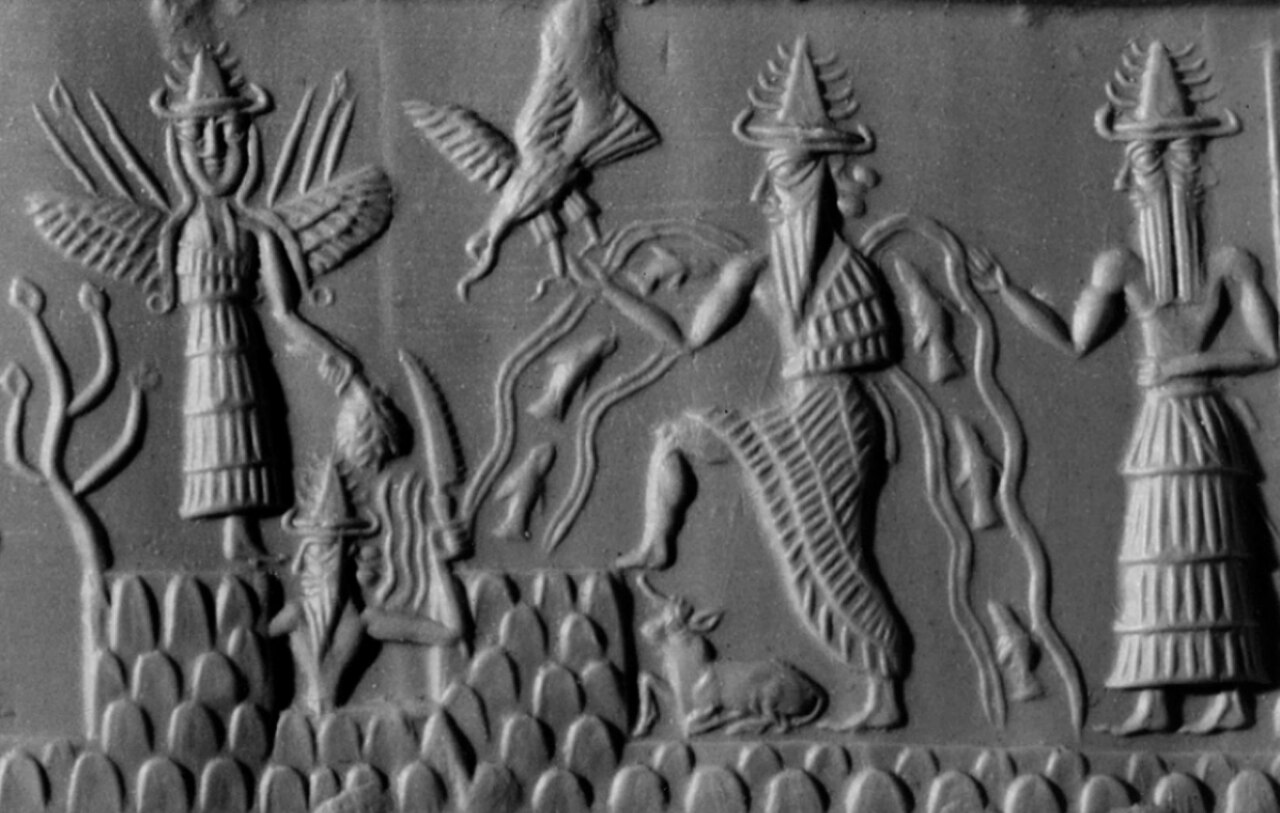
Enki (Ea)
The freshwater god of wisdom, magic, and the 'me' (the divine decrees); his great temple was at Eridu (the oldest city in Sumerian tradition). In the Atrahasis and the Gilgamesh flood-story, he saves the flood-hero against Enlil's will.

Who they are
- The freshwater god of wisdom, magic, and the 'me' [S5]S5 · etcl.mca.edu — Electronic Text Corpus of cuneiform (transliterations + translations)corpus (Sumerian/Akkadian texts)corpusOpen source ↗.
- His great temple was at Eridu (the 'Aabzu') [S5]S5 · etcl.mca.edu — Electronic Text Corpus of cuneiform (transliterations + translations)corpus (Sumerian/Akkadian texts)corpusOpen source ↗[S6]S6 · Met Museum Mesopotamian collection (open access)museummuseumOpen source ↗.
- Saves the flood-hero against Enlil's will (Atrahasis, Gilgamesh) [S2]S2 · Epic of Gilgamesh (Standard Babylonian version)c. 1200 BCEtextOpen source ↗[S3]S3 · AtrahasisOld Babylonian c. 17th c. BCEtextOpen source ↗.
- The 'apku' (the sage), patron of the scribes [S5]S5 · etcl.mca.edu — Electronic Text Corpus of cuneiform (transliterations + translations)corpus (Sumerian/Akkadian texts)corpusOpen source ↗.
- Enki's 'wisdom' role is central; his relationship to the 'me' (the divine decrees) is complex: he is both a holder and a distributor of the 'me' [S5]S5 · etcl.mca.edu — Electronic Text Corpus of cuneiform (transliterations + translations)corpus (Sumerian/Akkadian texts)corpusOpen source ↗.
Connections
Family & kinship
Conflict & enmity
Alliances & rule
Their corner of the divine world
- parentage
- marriage ♥
far = primordials · medium = all · close = detail — scroll/pan, click a deity to focus
5 stories
The Enuma Elish (the Babylonian Creation Epic)
The Enuma Elish is the great Babylonian creation epic, the 'New Year' (Akitu) festival text. In it, the gods (the 'Apsu' and the 'Tiamat' generations) are in conflict; the young gods (led by Marduk) are chosen to fight Tiamat. Marduk slays Tiamat with his bow, net, and 'rakasu' winds, splits her body in two to make the sky (upper half) and the earth (lower half), and from Kingu's blood (Tiamat's general) creates humanity. Marduk takes the 'Tablet of Destinies' and becomes the king of the gods [S1]S1 · Enuma Elish (Babylonian Creation Epic)Old Babylonian version c. 18th c. BCE; standard form c. 1100-1000 BCEtextOpen source ↗.
The Sumerian Creation (An and Ki)
In Sumerian cosmology, An (the sky) and Ki (the earth) are the first pair — the 'parents' of the world. From their union (or from the separation of heaven and earth), the gods and the world emerge [S5]S5 · etcl.mca.edu — Electronic Text Corpus of cuneiform (transliterations + translations)corpus (Sumerian/Akkadian texts)corpusOpen source ↗. The 'Apsu' (the fresh water) and the 'Tiamat' (the salt water) are the two primeval waters [S5]S5 · etcl.mca.edu — Electronic Text Corpus of cuneiform (transliterations + translations)corpus (Sumerian/Akkadian texts)corpusOpen source ↗.
The Flood (Atrahasis / Gilgamesh)
In the Atrahasis and the Gilgamesh flood-story, the gods (led by Enlil) decide to destroy humanity with a flood (because humanity's noise/disturbance is too great). Enki (Ea) saves the flood-hero (Atrahasis in the Atrahasis; Utnapishtim in the Gilgamesh) by whispering to him to build a boat. The flood destroys all life, but the flood-hero (and his family) survive. The flood-hero is later made immortal (in the Gilgamesh) [S2]S2 · Epic of Gilgamesh (Standard Babylonian version)c. 1200 BCEtextOpen source ↗[S3]S3 · AtrahasisOld Babylonian c. 17th c. BCEtextOpen source ↗.
Inanna's Descent to the Underworld
The great Sumerian myth of 'Inanna's Descent to the Underworld': Inanna descends to the underworld to attend the funeral of her sister Ereshkigal (the underworld-goddess). At the seven gates of the underworld, Inanna is stripped of her powers (her crown, her weapons, her jewelry) one by one. At the bottom, Ereshkigal kills Inanna (she is hung on a peg as a corpse). Enki (the wisdom god) is moved to pity and sends a being (the 'galatur' or the 'keshig') to bring Inanna back. Inanna is restored, but must send a 'stand-in' (her consort Dumuzi) to the underworld in her place [S4]S4 · Inanna's Descent to the Underworldc. 1900-1700 BCE (Sumerian)textOpen source ↗[S5]S5 · etcl.mca.edu — Electronic Text Corpus of cuneiform (transliterations + translations)corpus (Sumerian/Akkadian texts)corpusOpen source ↗.
Enlil and the 'Erosion' of the World (the flood-decree)
In the Atrahasis and the Gilgamesh flood-story, Enlil (the king of the gods) decrees the flood because humanity's noise/disturbance is too great. The 'erosion' of the world (the flood) is Enlil's decree to destroy humanity [S2]S2 · Epic of Gilgamesh (Standard Babylonian version)c. 1200 BCEtextOpen source ↗[S3]S3 · AtrahasisOld Babylonian c. 17th c. BCEtextOpen source ↗. Enki (Ea) saves the flood-hero against Enlil's will [S2]S2 · Epic of Gilgamesh (Standard Babylonian version)c. 1200 BCEtextOpen source ↗[S3]S3 · AtrahasisOld Babylonian c. 17th c. BCEtextOpen source ↗.
Depictions