Ra
The sun god, king of the gods, who travels across the sky by day and through the Duat by night; he is defeated nightly by Apep and reborn each dawn.

Who they are
- The sun god and king of the gods [S4]S4 · Hornung, 'The Ancient Egyptian Books of the Dead' / 'Nile Religion' (academic)modern (translation & scholarship)academic.
- Travels across the sky by day and through the Duat by night [S2]S2 · Book of the Dead (e.g., Papyrus of Ani)c. 1250 BCEtextOpen source ↗[S4]S4 · Hornung, 'The Ancient Egyptian Books of the Dead' / 'Nile Religion' (academic)modern (translation & scholarship)academic.
- Defeats Apep nightly [S2]S2 · Book of the Dead (e.g., Papyrus of Ani)c. 1250 BCEtextOpen source ↗[S4]S4 · Hornung, 'The Ancient Egyptian Books of the Dead' / 'Nile Religion' (academic)modern (translation & scholarship)academic.
- Fused with Amun to become Amun-Ra [S4]S4 · Hornung, 'The Ancient Egyptian Books of the Dead' / 'Nile Religion' (academic)modern (translation & scholarship)academic.
- Ra's 'creation' role (as Atum) is specifically Heliopolitan; other traditions give the creation role to Ptah or the Ogdoad [S4]S4 · Hornung, 'The Ancient Egyptian Books of the Dead' / 'Nile Religion' (academic)modern (translation & scholarship)academic.
Connections
Conflict & enmity
Alliances & rule
Their corner of the divine world
- parentage
- marriage ♥
far = primordials · medium = all · close = detail — scroll/pan, click a deity to focus
3 stories
The Heliopolitan Creation (Atum-Ra)
In the Heliopolitan tradition, the self-created god Atum-Ra rose from the primordial waters (Nun) — sometimes on a mound of earth (the benben). From his own body he created Shu (air) and Tefnut (moisture), the first divine pair. Their children were Geb (earth) and Nut (sky). This is the genealogy behind the Osiris cycle [S1]S1 · Pyramid Textsc. 2400–2300 BCEtextOpen source ↗[S4]S4 · Hornung, 'The Ancient Egyptian Books of the Dead' / 'Nile Religion' (academic)modern (translation & scholarship)academic.
Ra's Journey Through the Duat (the Night)
Each night, the sun god Ra enters the Duat (the underworld) in his 'Night Barque' and travels through the twelve hours of the night. At the hour of greatest danger (around midnight), the chaos serpent Apep strikes; Thoth and other gods help Ra defeat Apep. Ra rises again at dawn [S2]S2 · Book of the Dead (e.g., Papyrus of Ani)c. 1250 BCEtextOpen source ↗[S4]S4 · Hornung, 'The Ancient Egyptian Books of the Dead' / 'Nile Religion' (academic)modern (translation & scholarship)academic. The justified dead 'sail with Ra' through the night [S2]S2 · Book of the Dead (e.g., Papyrus of Ani)c. 1250 BCEtextOpen source ↗[S4]S4 · Hornung, 'The Ancient Egyptian Books of the Dead' / 'Nile Religion' (academic)modern (translation & scholarship)academic.
The Eye of Ra (Hathor/Sekhmet)
Ra's eye (variously identified with Hathor, Tefnut, or Sekhmet) was sent out to punish humanity for plotting against Ra. The eye became enraged and was transformed into Sekhmet, the warrior lioness, who slaughtered the rebels. To calm her, Ra (or Thoth) devised a trick: he brewed a potion dyed red with beet juice (to look like blood) and flooded the land with it; Sekhmet, thinking she had drunk the blood of her victims, became drunk and calm, and returned as Hathor [S3]S3 · Plutarch, On Isis and Osirisc. 79 CEtextOpen source ↗[S4]S4 · Hornung, 'The Ancient Egyptian Books of the Dead' / 'Nile Religion' (academic)modern (translation & scholarship)academic.
Objects they wielded, forged, or were bound to
INTERPRETIVE CLASSIFICATION · FULL PROFILE IN THE DIVINE VAULT

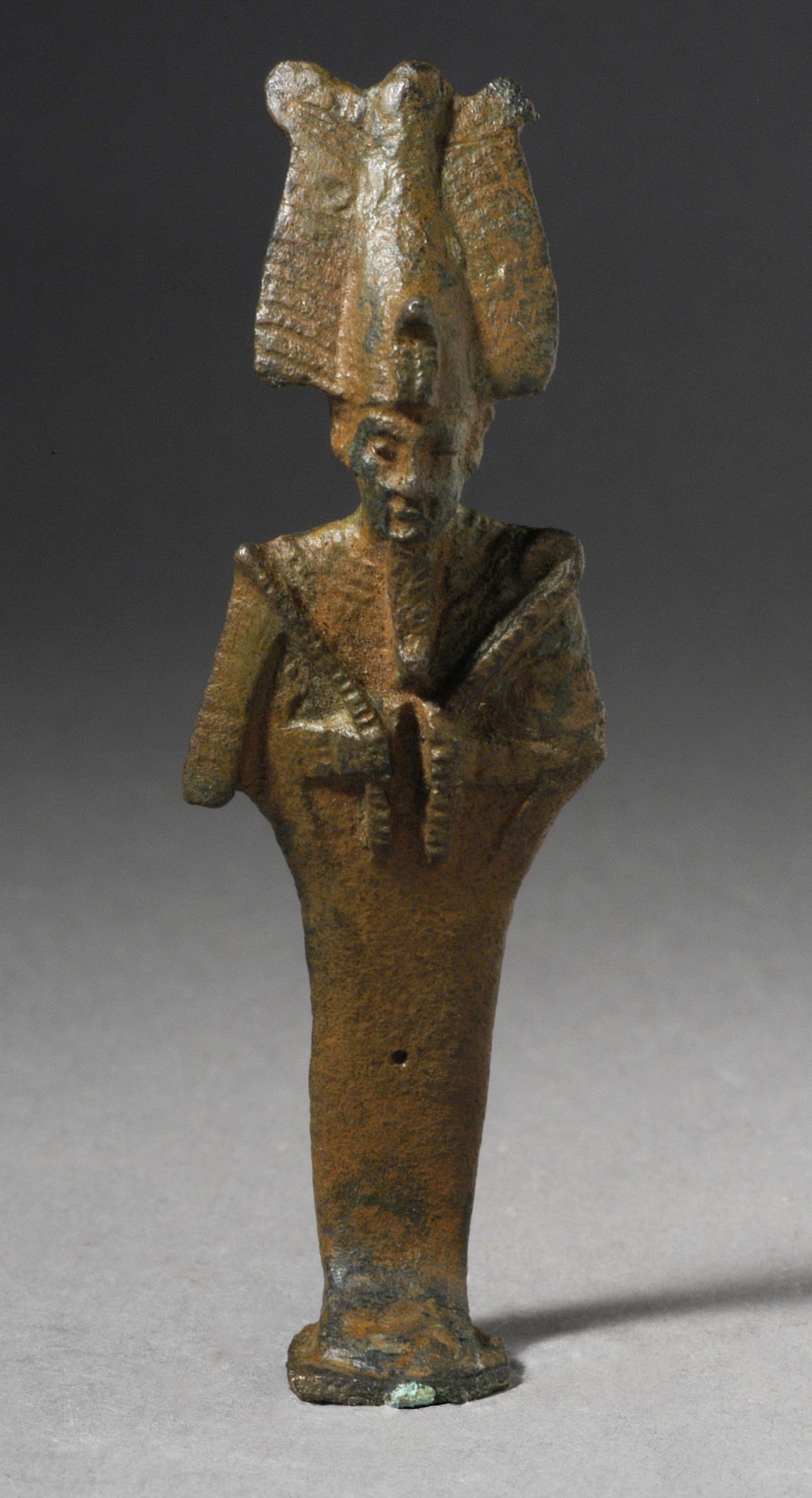
Depictions
